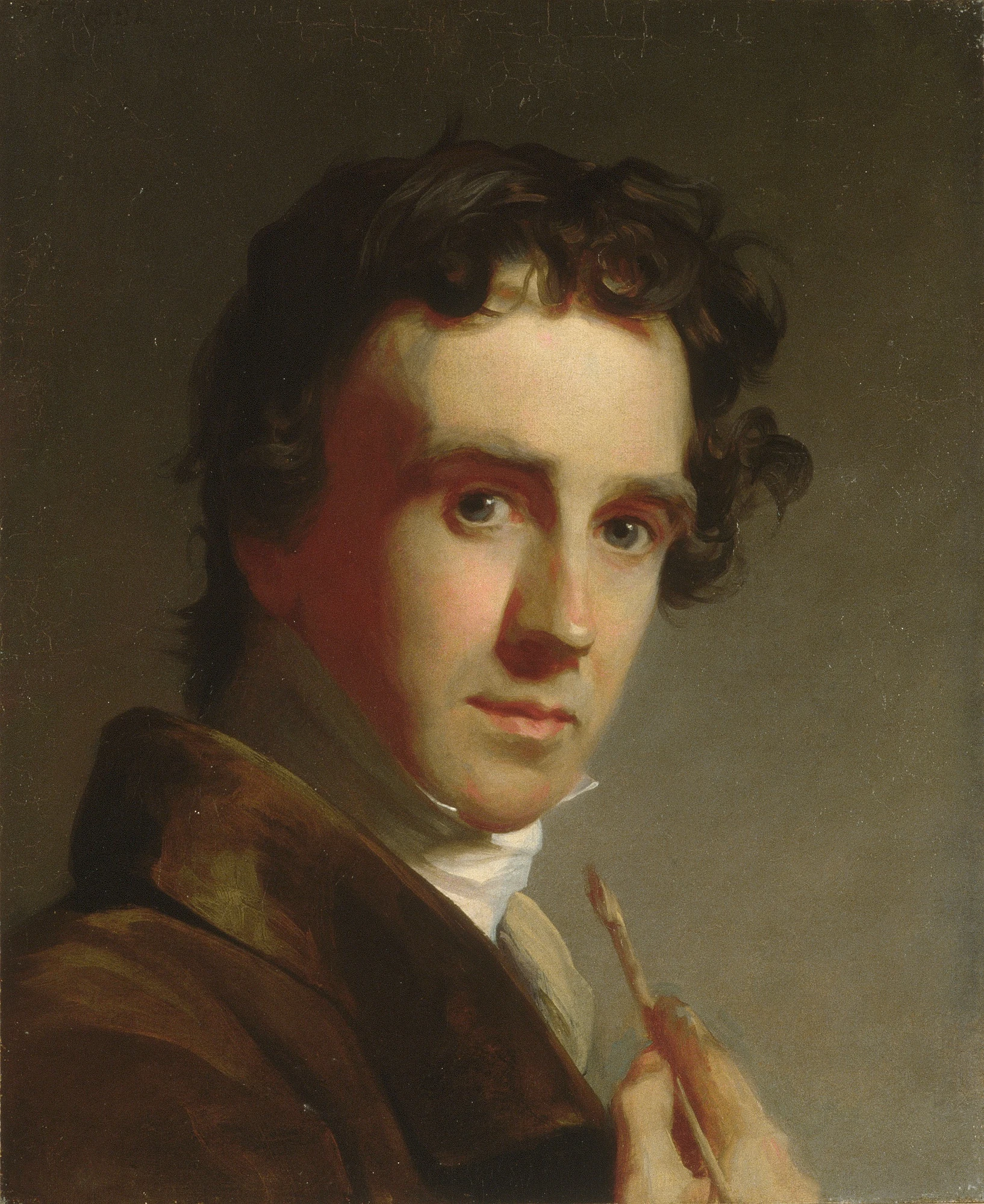
This self-portrait shows the artist turning to look at the viewer, brush in hand, as if momentarily interrupted in his work. Thomas Sully painted this intimate oil on canvas for his host in Baltimore, Maryland, the broker Henry Robinson, beginning the work on May 8, 1821, and completing it just one week later on May 15, according to his meticulously kept register. The painting measures seventeen and one-eighth by fourteen inches, a modest scale appropriate for a personal gift. The composition employs the convention of showing the artist with brush in hand, a device common in self-portraits that Sully adapted from a similar work by Benjamin West, with whom he had studied in London. Thomas Sully (1783-1872) was an English-born artist who became one of America's most accomplished and prolific portrait painters. He became a naturalized American citizen in 1809 and lived most of his life in Philadelphia, Pennsylvania, where he established himself as the leading portraitist of his generation. Sully's refined technique and ability to flatter his sitters without sacrificing likeness made him highly sought after by American society. His career spanned more than six decades, during which he painted approximately 2,600 works, including portraits of prominent Americans and historical subjects. The painting entered the Metropolitan Museum's collection in 1894 as a gift from Mrs. Rosa C. Stanfield, in memory of her father, Henry Robinson, the original recipient. This provenance connects the work directly to its creation, preserving the personal relationship between artist and patron that occasioned the portrait.