Ctrl K
Occupations
Hishikawa Moronobu (1618–1694) holds an unassailable position in Japanese art history as the founder of ukiyo-e, the 'pictures of the floating world' that would become Japan's most internationally recognized art form. Born in the provincial town of Yasuda during the early Edo period, Moronobu transformed woodblock printing from a purely utilitarian craft into an independent artistic medium, establishing both the technical foundations and aesthetic principles that would guide ukiyo-e for the next two centuries. His achievement was not merely technical but conceptual: he elevated the depiction of contemporary urban life—kabuki actors, courtesans, merchants, and pleasure quarters—to a subject worthy of serious artistic treatment. Morenobu's background in textile design, inherited from his father's embroidery business, profoundly influenced his artistic development. The bold, flowing patterns of textile decoration translated remarkably well to woodblock printing, giving his work a distinctive linear quality and rhythmic energy. After moving to Edo (present-day Tokyo) in the 1660s, Moronobu established himself as a book illustrator, creating designs for popular fiction, guidebooks, and educational texts. His illustrations demonstrated unprecedented artistic sophistication, and by 1672, his success was such that he became the first book illustrator to sign his work—a revolutionary assertion of artistic identity in what had been an anonymous craft. Perhaps Moronobu's most significant innovation was the development of the single-sheet print (ichimai-e), independent from any accompanying text. These standalone images, which depicted scenes from Edo's entertainment quarters and theatrical world, established woodblock printing as a distinct artistic genre capable of existing independently from book illustration. His style—characterized by confident brushwork, dynamic compositions, and powerful linear rhythms—set the aesthetic standard for all subsequent ukiyo-e masters. From Harunobu and Utamaro to Hokusai and Hiroshige, every major ukiyo-e artist built upon the foundation that Moronobu established, making him not merely an important artist but the originator of an entire artistic tradition.
Hishikawa Moronobu was born in 1618 in Yasuda (also known as Hota), a small town in Awa Province (present-day Chiba Prefecture), located on the Bōsō Peninsula across Edo Bay from the growing capital city of Edo. His father, Hishikawa Kichizaemon, was a skilled textile dyer and embroiderer who specialized in nuihaku—a technique involving the application of gold and silver leaf to embroidered fabrics, commonly used for Noh theater costumes.
Growing up in his father's workshop, young Moronobu absorbed the aesthetic principles and technical skills of textile design. The training he received emphasized bold, flowing patterns, rhythmic compositions, and the effective use of positive and negative space—all qualities that would later characterize his woodblock prints. In the Edo period, textile design was not considered a fine art but rather a commercial craft; however, it demanded sophisticated visual sense and technical precision. This background in applied arts, rather than traditional painting, would prove crucial to Moronobu's later innovations.
During these early years, Moronobu likely also studied painting, possibly in the Kanō school or the Tosa school traditions, though specific details of his artistic training remain unclear. What is certain is that by the time he reached middle age, he had mastered multiple artistic techniques and possessed a thorough understanding of both traditional painting methods and the practical demands of design for reproduction.
The Yasuda region where Moronobu grew up was not a major cultural center, but its proximity to Edo meant that news of urban developments and cultural trends would have reached the town. By the middle of the seventeenth century, Edo was rapidly growing into Japan's largest and most dynamic city, with a burgeoning merchant class eager for entertainment and cultural products. This emerging market would eventually draw Moronobu, like many ambitious artisans and artists, to seek his fortune in the great metropolis.
Around 1662, following his father's death, Moronobu relocated to Edo to pursue a career in art. This move, occurring when he was in his mid-forties, was relatively late for someone establishing a new profession, but Moronobu possessed a maturity and mastery that would serve him well. Edo in the 1660s was entering its cultural golden age. The Yoshiwara licensed pleasure quarter had been relocated to its new northern location, kabuki theater was flourishing, and a sophisticated urban culture was developing around the tastes of the merchant class (chōnin).
Moronobu initially established himself as an illustrator for woodblock-printed books, a medium that was experiencing tremendous growth. Japanese publishing had expanded dramatically since the introduction of movable type in the late sixteenth century, and by the mid-seventeenth century, woodblock printing had become the dominant technology for book production. Publishers produced works of popular fiction, guidebooks to entertainment districts, manuals on various subjects, and collections of poetry, all illustrated with woodblock prints.
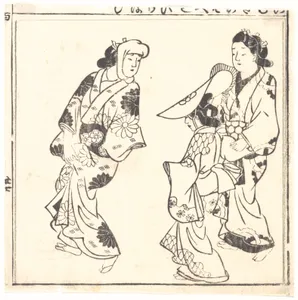
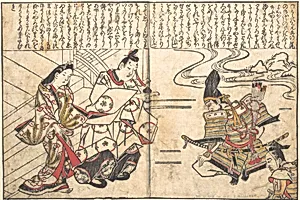
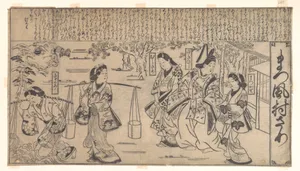
What distinguished Moronobu's book illustrations from those of his predecessors was their artistic sophistication. While earlier book illustrations had been crude and utilitarian, Moronobu brought a refined aesthetic sense, dynamic compositions, and confident draftsmanship to the medium. His figures possessed grace and energy; his scenes demonstrated careful spatial organization; his lines flowed with rhythmic vitality. He illustrated books of various genres, including kana-zōshi (popular fiction), sharebon (guidebooks to the pleasure quarters), and educational texts.
A crucial development occurred in 1672: Moronobu became the first book illustrator to sign his work consistently. This seemingly small gesture had profound implications. By signing his illustrations, Moronobu asserted his identity as an artist rather than an anonymous craftsman. He claimed authorship and artistic agency, transforming book illustration from a commercial craft into a vehicle for personal artistic expression. This assertion of artistic identity marked a crucial step in elevating the status of woodblock printing and laid the groundwork for ukiyo-e's development as an independent art form.
By the mid-1670s, Moronobu had achieved substantial success as a book illustrator, but his most revolutionary contribution still lay ahead. Around this time, he began producing single-sheet woodblock prints (ichimai-e) that existed independently from any accompanying text. These works represented a fundamental shift: rather than serving as illustrations for written narratives, they were autonomous visual compositions that told their own stories or simply presented beautiful images for aesthetic appreciation.
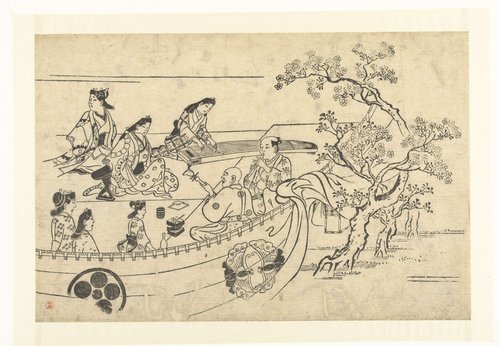
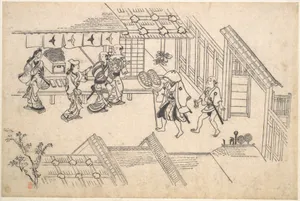
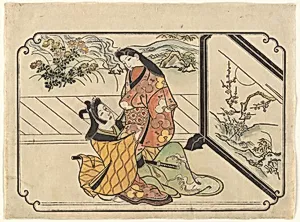
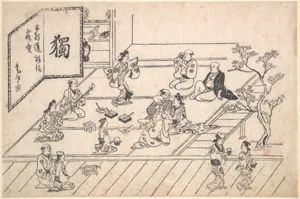
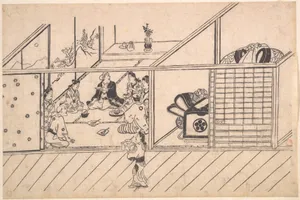
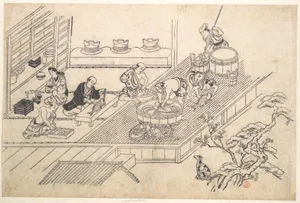
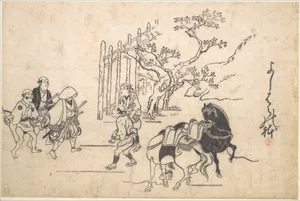
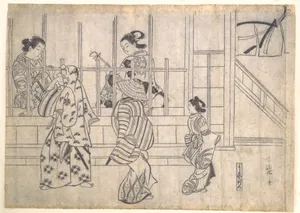
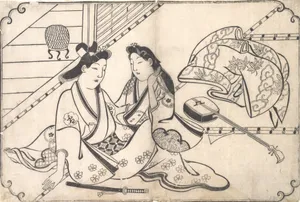
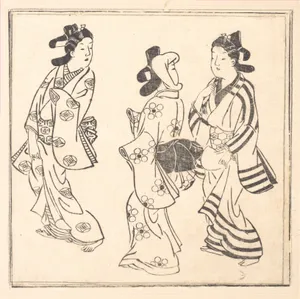
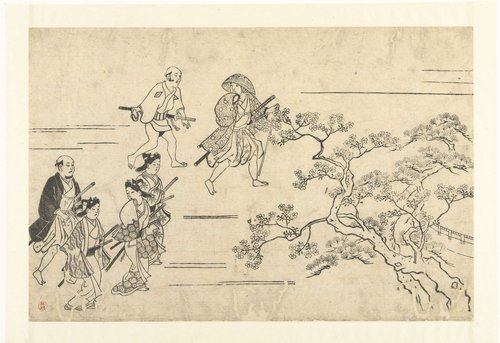
This innovation of the single-sheet print was technically simple but conceptually revolutionary. It established woodblock printing as an art form in its own right, not merely a reproductive technique for illustrating texts. These prints depicted subjects drawn from Edo's urban culture: beautiful women (bijin), scenes from the Yoshiwara pleasure quarter, kabuki actors, and views of famous places within the city. They were affordable, appealing to the prosperous merchant class and samurai, and could be displayed in homes, collected, or given as gifts.
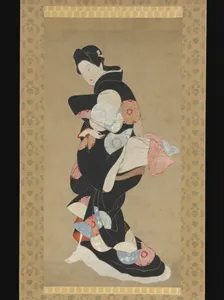
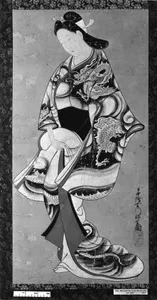
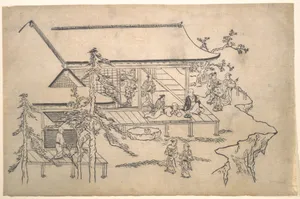
Moronobu's early single-sheet prints were executed in black ink alone (sumizuri-e), without color beyond what might be hand-applied after printing. Despite this limitation, his mastery of line and composition created images of remarkable visual impact. His most famous work from this period is the hanging scroll 'Beauty Looking Back' (Mikaeri Bijin), probably created around 1690, which depicts a woman in elegant robes turning to glance over her shoulder. This image, with its graceful curves, confident linework, and psychological presence, epitomizes Moronobu's achievement and has become one of the most iconic images in Japanese art.
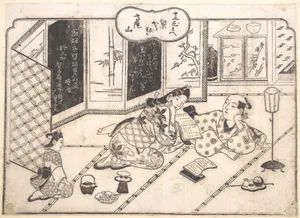
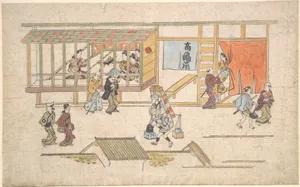
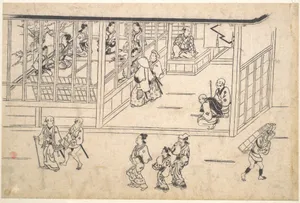
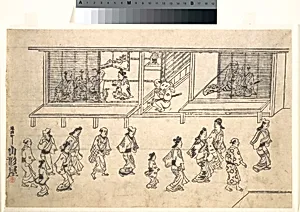
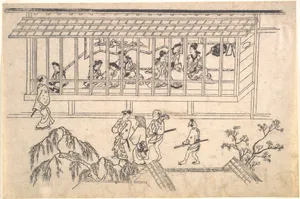
During this period, Moronobu also produced several important series of prints, including the twelve-print series 'Scenes from the Gay Quarters at Yoshiwara.' These works documented the life and customs of Edo's licensed pleasure quarter with both artistic sophistication and ethnographic detail. They appealed to customers who might never visit Yoshiwara themselves, offering a voyeuristic glimpse into a glamorous world, while also serving as souvenirs for those who did frequent the district.
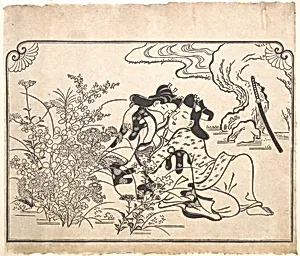
By 1680, Moronobu had become the most important ukiyo-e printmaker in Edo, a position he would maintain until his death. His workshop produced an enormous volume of work—book illustrations, single-sheet prints, and paintings—employing assistants and students who helped execute designs under his supervision. Estimates suggest he may have produced more than 100 illustrated books, perhaps as many as 150, along with numerous single-sheet prints and paintings. Approximately twenty of his illustrated books were of an explicitly erotic nature (shunga), a genre that Moronobu helped establish and that would remain an important part of ukiyo-e throughout its history.
Moronobu's mature works demonstrated increasing sophistication in composition and technique. His depictions of human figures, particularly women, combined idealization with psychological presence. His men and women possess distinctive personalities; they are not mere types but individuals captured in characteristic moments. His compositions, informed by his textile design background, demonstrated sophisticated understanding of pattern, rhythm, and the relationship between figure and ground.
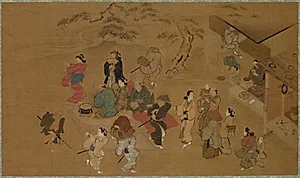
One of Moronobu's significant achievements was the handscroll 'The Gay Quarters and the Kabuki Theatre,' which provided a panoramic view of Edo's entertainment culture. This work, painted rather than printed, demonstrated that Moronobu was not merely a printmaker but a serious artist capable of working in multiple media. Throughout his career, he moved fluidly between painting and printmaking, never allowing the commercial nature of ukiyo-e to limit his artistic ambitions.
Moronobu's influence extended beyond his own production. He trained numerous students and established a workshop tradition that would continue after his death. His sons and students carried forward his style and techniques, though none achieved his level of innovation. More importantly, he established the fundamental vocabulary of ukiyo-e: the subjects, compositional strategies, linear style, and aesthetic principles that would guide the art form for the next two centuries.
Hishikawa Moronobu died in 1694 in Edo at approximately seventy-six years of age. By the time of his death, he had transformed woodblock printing from a utilitarian craft into a recognized art form and established ukiyo-e as a distinctive school of Japanese painting and printmaking. While later artists would introduce innovations in color printing, perspective, and subject matter, they all built upon the foundation that Moronobu created. His achievement was not merely technical but conceptual: he demonstrated that contemporary urban life—the floating world of pleasure and entertainment—was a subject worthy of serious artistic treatment.
Artheon Research Team
Last updated: 2025-11-09
Biography length: ~1,764 words
Wikidata (CC0)