
Ctrl K
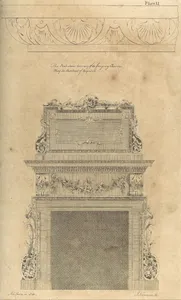
**Abraham Swan** (British, active 1745–68) was an architect and author best known for his influential pattern book *The British Architect; or, the Builder’s Treasury of Staircases*, first published in London in 1745. The volume provided Georgian-era builders and carpenters with detailed designs for staircases, doors, windows, chimney-pieces, and other interior and exterior elements, illustrated with numerous engraved plates. Swan’s work drew on contemporary British architectural practice and quickly became a standard reference, going through multiple English editions.
In 1775 the book reached colonial America when Philadelphia printer and publisher **Robert Bell** (1732–1784) issued the first American edition. Engraver and publisher **John Norman** (American, born England, ca. 1748–1817), who had recently arrived from London, prepared or contributed to the plates for this Philadelphia printing. Norman later moved to Boston, where he continued his career as an engraver and map publisher. The 1775 edition, produced “by R. Bell for John Norman,” marked the first architectural treatise printed in the colonies and helped transmit British design principles to American builders during the Revolutionary era.
Swan’s designs found particular favor in Philadelphia and the mid-Atlantic, influencing both public and domestic architecture. The pattern book’s clear, practical illustrations made sophisticated Georgian details accessible to local craftsmen working far from London. Norman’s involvement in the American reprint underscores the transatlantic exchange of artistic and technical knowledge in the late eighteenth century.
Although little is recorded about Swan’s personal training or later life, his single major publication secured his place in architectural history. The 1775 Philadelphia edition remains a landmark in early American printing and design dissemination, preserving Swan’s legacy through the work of Bell and Norman.
All 1 artworks loaded