
Ctrl K
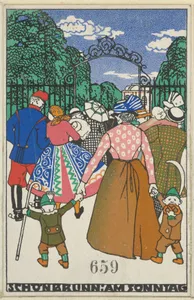
**Adalberta Kiessewetter (later Berta or Bertha Wallner) was an Austrian graphic artist and illustrator born on February 24, 1887, in Leitmeritz (Litoměřice), Bohemia, into a German-speaking family.** Her father, engineer Friedrich Kiessewetter, moved the family to Vienna in 1901. She trained first at the Malschule Kruis-Hohenberger before enrolling from 1905 to 1909 at Vienna’s Kunstgewerbeschule (School of Applied Arts), where she studied painting under Carl Otto Czeschka and Bertold Löffler.
Her early work reflected the school’s emphasis on applied design and graphic arts. She exhibited woodcuts and poster designs as a student, including at the 1908 Kunstschau and in publications such as *Die Fläche* and *Etiquetten-Schatz*. In 1911 she married fellow student, the painter Ludwig Wallner, who died in World War I the following year.
Kiessewetter became best known for her contributions to the Wiener Werkstätte. Between 1911 and 1912 she designed at least eleven color lithograph postcards featuring whimsical, caricatural views of Vienna—scenes of the Prater, Schönbrunn Zoo on Sundays, the City Park, old rooftops, and market areas. These lively, linear compositions captured everyday urban life with a playful, slightly skewed perspective that remains distinctive. She also created commercial illustrations, labels, and collectible images for brands such as Stollwerck.
After moving to Salzburg around 1912, she continued exhibiting drawings and later focused on book illustration, producing charming line drawings for children’s books and school readers in the 1920s and 1930s. She showed work sporadically into the 1940s and 1950s. Her death date remains undocumented, with the last known records placing her in the Salzburg region after 1948.
Though her career was largely devoted to commercial and applied graphics rather than fine-art painting, Kiessewetter’s postcards and illustrations preserve a vivid, personal record of early-twentieth-century Viennese visual culture and demonstrate the reach of the Kunstgewerbeschule’s design ethos through the Wiener Werkstätte. Her work continues to appear in museum collections and postcard reproductions today.