
Ctrl K
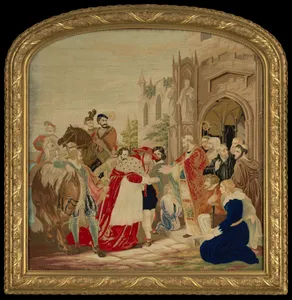
**Agnes (Pruyn) Strain (1839–1898)** was an American needlework artist from Albany, New York, best known for her intricate Berlin wool work depicting scenes from Shakespeare’s plays. Born Agnes Pruyn on July 6, 1839, she was the daughter of Mary Putnam Pruyn (1820–1885), a missionary associated with the Woman’s Union Missionary Society. Agnes married Robert Strain and raised a family in Albany before later connections to Philadelphia, where she died on May 7, 1898.
Her artistic output centers on domestic textile arts popular in the Victorian era. The primary work attributed to her is a detailed needlework picture of a scene from Shakespeare’s *Henry VIII*, created around 1865 using wool and silk on linen canvas in the Berlin wool work technique. Museum records note it as “probably by Agnes (Pruyn) Strain,” with a possible contribution or earlier execution by her mother, Mary (Putnam) Pruyn. This piece entered the collection of the Metropolitan Museum of Art and remains a notable example of 19th-century American needlework interpreting literary themes.
No formal art training, teachers, or affiliation with specific schools or movements is documented for Strain. Like many women of her time, she likely developed her skills through domestic practice and the widespread popularity of Berlin wool work patterns, which allowed precise, colorful pictorial embroidery often based on prints or illustrations.
Strain’s legacy rests on this single surviving work preserved in a major public collection, offering insight into the artistic pursuits of 19th-century American women outside professional fine-art circles. Her needlework bridges personal craft traditions with literary culture, and the piece continues to be studied for its technical execution and historical context within Victorian decorative arts.
All 1 artworks loaded