
Ctrl K
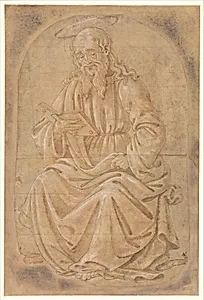
**Alesso Baldovinetti** (c. 1425/1427–1499) was a Florentine painter of the Early Renaissance whose work bridged the innovations of the first generation of quattrocento masters with the refined naturalism of the later 15th century. Born in Florence to a wealthy merchant family, he rejected the expected path in commerce to pursue art, joining the painters’ guild, the Compagnia di San Luca, in 1448.
He trained and worked as an assistant to Domenico Veneziano, whose luminous, clear style profoundly shaped his approach to light and form. Baldovinetti was also deeply influenced by Fra Angelico and Andrea del Castagno, collaborating with the latter on fresco cycles, including work in the high chapel of Sant’Egidio. These experiences grounded him in the Florentine tradition of precise modeling, atmospheric perspective, and careful observation of the natural world.
Baldovinetti’s mature style is exemplified by his masterpiece, the fresco *The Nativity* (1460–62) in the Church of Santissima Annunziata in Florence. Though his experimental fresco techniques caused the work to deteriorate rapidly, it remains notable for its pale colors, integrated landscape views of the Arno River valley, and harmonious balance of detail with large-scale design. Other significant works include an altarpiece for the Pieve di Borgo San Lorenzo (c. 1450) and the *Madonna and Child* (c. 1465), both demonstrating his pioneering contributions to landscape painting in European art.
His legacy lies in advancing the depiction of light and landscape within the Early Renaissance framework, influencing subsequent generations of Florentine artists. Baldovinetti died in Florence in 1499 and was buried in San Lorenzo, leaving behind a body of work that exemplifies the progressive spirit of 15th-century Florentine painting.