Ctrl K
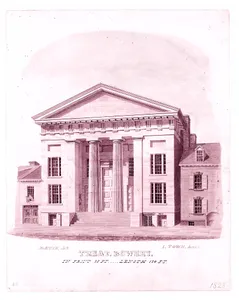
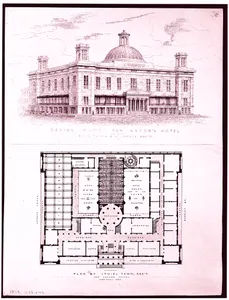
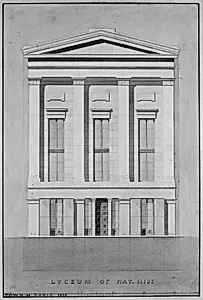
Alexander Jackson Davis (1803–1892) and Ithiel Town (1784–1844) were pioneering American architects whose partnership from 1829 to 1835 marked the birth of the first recognizably modern architectural firm in the United States. Born in Thompson, Connecticut, to a farming family, Town trained under Asher Benjamin in Boston and gained fame as an inventor with his patented lattice truss bridge design in 1820, which revolutionized bridge construction worldwide. Davis, born in New York City to a bookseller, apprenticed in printing before studying at the American Academy of the Fine Arts, the New-York Drawing Association, and the National Academy of Design's antique school; he worked as a draftsman for Gothic Revival exponent Josiah R. Brady and then joined the prestigious firm of Ithiel Town and Martin E. Thompson in 1826, accessing Town's unparalleled architectural library.
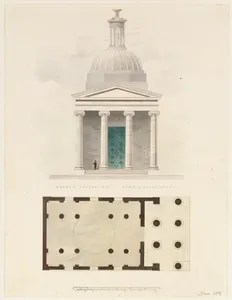
Together as Town and Davis (briefly expanded to include James H. Dakin in 1832–1833), they championed the Greek Revival style for grand public commissions, blending neoclassical precision with innovative engineering. Key works include the Indiana Statehouse (1831–1835), North Carolina State Capitol (1833–1840), U.S. Custom House in New York City (1833–1842, now Federal Hall National Memorial), Colonnade Row on Lafayette Street (1833), and Wadsworth Atheneum in Hartford (1842). Town's earlier solo designs, such as Center Church (1812–1815) and Trinity Church on the Green (1813–1816) in New Haven—both blending Federal and Gothic elements—laid the groundwork for their firm's eclectic approach.
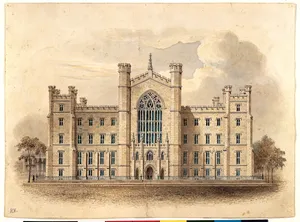
After the partnership dissolved in 1835, Town continued with Greek Revival projects like the Potomac Aqueduct (1833–1843) until his death, while Davis married Margaret Beale in 1853 and pioneered picturesque country houses in Gothic Revival and Italianate styles, publishing *Rural Residences* (1837–1838) to popularize Tuscan villas and domesticated Gothic cottages. Davis's masterpieces include Lyndhurst in Tarrytown, New York (1838, expanded 1864), Blandwood Mansion in Greensboro, North Carolina (1844), and the Virginia Military Institute campus (1848–1850s), the first fully Gothic Revival college ensemble; he also designed Llewellyn Park (late 1850s), an early planned suburb in West Orange, New Jersey, where he died. Their legacies endure as founders of professional American architecture: Town through engineering innovations and his vast library donated to Yale, Davis via collaborations with Andrew Jackson Downing that shaped Hudson River Bracketed style, influencing generations of villa designers.