
Ctrl K
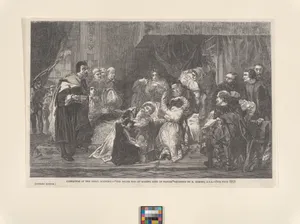
**Alfred Elmore** (1815–1881) was a British history and genre painter born in Clonakilty, County Cork, Ireland, the son of a retired British Army surgeon. His family relocated to London, where he studied at the Royal Academy of Arts. Early in his career, Elmore worked in the troubadour style associated with Richard Parkes Bonington before turning to religious subjects, including *The Martyrdom of Thomas à Becket*, commissioned by Daniel O’Connell for a Dublin church.
Between 1840 and 1844 he traveled through Europe, visiting Munich, Venice, Bologna, and Florence. He became loosely associated with The Clique, a group of artists inspired by Hogarth and Wilkie. Elmore’s mature output focused on historical narrative paintings, often exploring themes of invention and moral choice, as seen in *The Invention of the Stocking Loom* (1847) and *The Invention of the Combing Machine* (1862). His best-known work, the moral genre painting *On the Brink* (1865), depicts a young woman tempted by a satanic seducer after losing at gambling.
In later decades Elmore shifted toward a more classical manner influenced by Edward Poynter and Lawrence Alma-Tadema, while also exploring Orientalist subjects. He was elected a Royal Academician and continued exhibiting until health issues, including neuralgia and a riding accident, limited his activity. He died of cancer in London in 1881.
**Edward Dalziel** (1817–1905), a British painter, illustrator, and wood-engraver, was born in Wooler, Northumberland. He joined his brother George in founding the prolific Brothers Dalziel engraving firm in London in 1839–1840. The family business, which eventually included several siblings, became one of the leading wood-engraving workshops of the Victorian era, collaborating with major artists such as Millais, Rossetti, Holman Hunt, and Whistler on illustrations for books and magazines, including Lewis Carroll’s *Alice* books.
Edward contributed both engravings and original designs, helping shape the visual culture of the period until photo-mechanical reproduction displaced traditional wood-engraving. The firm also published its own ventures and acquired the humorous magazine *Fun*. Edward outlived most of his siblings and died in London in 1905.
Together these two artists represent the breadth of nineteenth-century British art: Elmore through ambitious history and genre painting, and Dalziel through the vital craft of illustration and printmaking that brought art to a wide public.
All 1 artworks loaded