
Ctrl K
**Étienne Delaune** (also spelled Delaulne or De Laune) was a French goldsmith, medallist, draughtsman, and engraver born in 1518 or 1519, probably in Orléans, and active primarily in Paris before later years in Strasbourg, where he died around 1583.
He worked as a goldsmith in Paris during the 1550s and received an appointment to the royal mint in 1552, though he left after six months due to a wage dispute. This position helped him forge connections at the French court, leading to commissions for intricate designs of royal armor, medals, and other metalwork. He began his engraving career with medals and is said to have received assistance from Benvenuto Cellini during the Italian artist’s time in Paris.
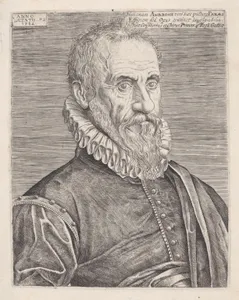
Delaune’s style drew heavily from the German Little Masters, emphasizing small-scale, highly detailed compositions executed with the burin. He produced numerous engravings after Raphael, the Italian masters of Fontainebleau, and designs by his son Jean, with whom he spent much of his later life in Strasbourg. Among his notable works are designs for parade armor associated with Henry II, circular dishes depicting biblical scenes such as the histories of Moses and Samson (examples preserved in the Louvre), and series including subjects from the Old Testament, mythological themes, the months of the year, and rural occupations. He also created a well-known portrait engraving of the royal surgeon Ambroise Paré in 1582.
Delaune ranks among the foremost designers of goldsmithery in 16th-century France and left a substantial legacy through his more than four hundred engravings, which influenced decorative arts and were widely reproduced. His courtly commissions and technical precision helped shape the visual language of the French Renaissance.