
Ctrl K
Yahya ibn Sharaf al-Nawawi, commonly known as Imam al-Nawawi, was born in 1233 in the village of Nawa near Damascus, Syria, during the Ayyubid Sultanate. From an early age, he demonstrated prodigious talent in religious sciences, moving to Damascus at 18 to study under renowned masters including Abu Ibrahim Ishaq bin Ahmad al-Maghribi, Abu Muhammad Abdur-Rahman bin Ibrahim al-Fazari, and Radiyuddin Abu Ishaq Ibrahim bin Abu Hafs Umar bin Mudar al-Mudari, among over twenty teachers. His rigorous training in hadith, fiqh, usul al-fiqh, syntax, and etymology shaped him into a leading Shafi'i jurist and hadith scholar, authoring over fifty works despite his short life, often writing more than forty pages daily.
Al-Nawawi's scholarly output profoundly influenced Islamic tradition, with key texts like *Riyadh as-Saliheen*, a collection of hadiths on ethics; *Al-Arba'in al-Nawawiyya* (Forty Hadiths); *Al-Majmu' sharh al-Muhadhab*, a comprehensive Shafi'i law manual; and *Kitab al-Adhkar*, featuring supplications and litanies including the celebrated *Hizb al-Nawawi*. He worked firmly in the Shafi'i school tradition, emphasizing meticulous hadith authentication and ethical guidance, and earned titles like Shaykh al-Islam for his asceticism and confrontations with rulers over justice. Returning to Nawa later in life, he died there in 1277 at age 45, leaving a legacy of devotion and scholarship revered across madhabs.
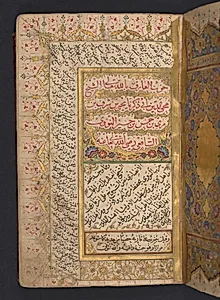
Though primarily a scholar rather than a visual artist, al-Nawawi's writings became cornerstones of Islamic manuscript art, inspiring exquisite calligraphic renditions centuries later. A prime example is the *Hizb (Litany) of An-Nawawi*, a portable Ottoman devotional codex copied in fine naskh script by the Turkish court calligrapher Muhammad al-Amin—self-described as "the weakest of calligraphers" and "famous as Successor (khalifa) of the Calligrapher"—in Istanbul in 1739. Adorned with gold ink, opaque watercolors, vegetal and geometric borders, and a striking maroon tooled binding, this work exemplifies Ottoman manuscript illumination traditions, blending scholarly piety with artistic elegance.
Al-Nawawi's enduring impact bridges scholarship and art: his concise, spiritually potent texts provided ideal content for generations of calligraphers, ensuring their preservation in lavishly decorated volumes. Honored as one of al-Shaykhayn alongside al-Rafi'i, his works remain printed worldwide, while artifacts like the Met's *Hizb* highlight how his legacy illuminated both minds and pages in the Islamic world.
No artworks found for this artist