
Ctrl K
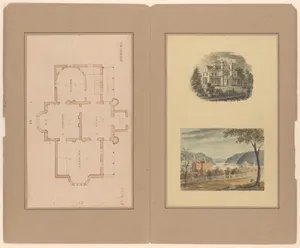
**Andrew Jackson Downing** (1815–1852) was an American landscape designer, horticulturist, and writer who became one of the most influential figures in 19th-century American design. Born in Newburgh, New York, to a nurseryman father, he left school at sixteen to join the family business and developed a deep interest in botany, landscape gardening, and architecture through self-directed study.
Downing’s career took off with the 1841 publication of *A Treatise on the Theory and Practice of Landscape Gardening, Adapted to North America*, the first major American book on the subject. He championed the picturesque style, drawing on English traditions while adapting them to the American context. In 1842 he collaborated with architect **Alexander Jackson Davis** on the influential pattern book *Cottage Residences*, published by Wiley and Putnam; the volume popularized Carpenter Gothic and other romantic styles through illustrated designs for rural homes and gardens. His later *The Architecture of Country Houses* (1850) further expanded these ideas, emphasizing beauty, utility, and moral improvement through thoughtful domestic environments. As editor of *The Horticulturist* magazine from 1846 until his death, he reached a wide audience with essays on horticulture, rural taste, and public parks.
Downing’s legacy endures as a founder of American landscape architecture. He collaborated briefly with Calvert Vaux on projects including grounds for the Smithsonian Institution and the White House, and his ideas directly influenced Frederick Law Olmsted and the design of Central Park. Though he died tragically young in a steamboat fire on the Hudson River in 1852, his pattern books and advocacy for naturalistic, morally uplifting landscapes shaped American suburbs, parks, and domestic architecture for generations.
All 1 artworks loaded