
Ctrl K
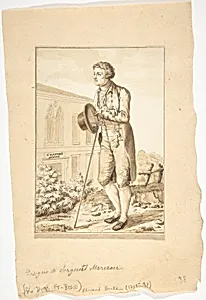
1751–1847
**Antoine Louis François Sergent, known as Sergent-Marceau (1751–1847), was a French painter, copper engraver, watercolorist, and printmaker whose career bridged the late Ancien Régime and the Revolutionary era.** Born in Chartres to a modest family, he showed early talent as a draftsman. In 1768 he moved to Paris to study engraving under the master Augustin de Saint-Aubin for three years, after which he returned to Chartres as a professional engraver and drawing teacher before settling permanently in the capital around 1784.
His artistic output centered on detailed historical and genre scenes rendered in aquatint and color engraving, often celebrating French history and notable figures. He produced a celebrated series of prints titled *Portraits des grands hommes, femmes illustres et sujets mémorables de France* (1786–1792), which depicted kings, military leaders, and memorable events in vibrant color. Other notable works include gouache views of Chartres, such as *Chartres, vue des Petits Près*, and illustrations for religious texts like the Chartres missal and breviary. After marrying Émira Marceau—sister of Revolutionary general François Séverin Marceau—in 1795, he adopted her surname, becoming Sergent-Marceau; the couple later adopted her nephew Agatophile Berchette.
Sergent-Marceau also played an active role in the French Revolution as a deputy to the National Convention for the Seine department, where he advocated for the preservation of artistic monuments and the creation of a national museum of painting and sculpture. His political involvement led to periods of exile in Switzerland and Italy, after which he returned to France and eventually settled in Nice in 1824, continuing to work as an artist until his death at age 95.
Today he is remembered for his technically accomplished engravings that captured the spirit of late-eighteenth-century France, with examples held in public collections including the Musée des Beaux-Arts in Chartres and the National Gallery of Art in Washington. His dual identity as artist and revolutionary figure makes him a vivid witness to one of the most turbulent periods in European history.