
Ctrl K
**Frederick Walker (1840–1875)** was a British painter and illustrator whose brief but brilliant career left a lasting mark on Victorian art. Born on 26 May 1840 in London as one of eight children, he showed early artistic talent, teaching himself to copy prints before pursuing formal study. He briefly worked in an architect’s office, attended James Mathews Leigh’s art school, and enrolled at the Royal Academy in 1858, though he soon apprenticed as a wood-engraver under Josiah Wood Whymper. There he met fellow artists J. W. North and George Pinwell, connections that shaped his illustrative career.)
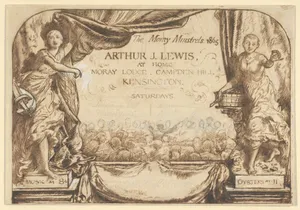
Walker achieved early success as a black-and-white illustrator for magazines such as *Cornhill Magazine* and books by William Thackeray, including *The Adventures of Philip*. He transitioned to painting in oils and watercolours, exhibiting regularly at the Royal Watercolour Society (becoming a full member in 1866) and the Royal Academy (elected Associate in 1871). His style blended social realism, genre scenes, and a poetic idealism that later critics associated with the “Idyllic school,” of which he is often regarded as the founder. Notable works include the watercolour *Spring* (1864, Victoria and Albert Museum), the oil *The Vagrants* (1868, Tate), and the large-scale *The Harbour of Refuge* (1872, Tate). He also created the design for an invitation card to The Moray Minstrels concerts hosted by patron Arthur James Lewis.)
Walker never married and lived with family in London until tuberculosis prompted travels to Algiers and ultimately Scotland, where he died on 4 June 1875 at age 35. Contemporary John Everett Millais called him “the greatest artist of the century,” and his innovative fusion of illustration techniques with fine art influenced later generations. Though his output was cut short, Walker’s sensitive depictions of rural and everyday life continue to be celebrated in major British collections.
All 1 artworks loaded