
Ctrl K
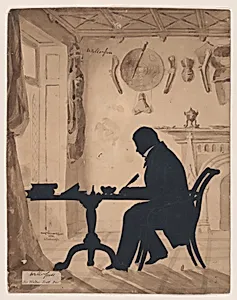
Auguste Amant Constant Fidèle Edouart (1789–1861), born in Dunkerque, France, as the sixteenth child in his family, initially managed a china factory before serving with distinction in the Napoleonic Wars, where several brothers perished. In 1814, he married Emilie Laurence Vital, with whom he had five children, and fled political turmoil for England. There, he supported his family through painstaking mosaic portraits woven from human hair, wax animal models exhibited at the Royal Academy, and brief French lessons. Self-taught with no formal artistic training, Edouart's silhouette career ignited spontaneously in late 1825 in Cheltenham. Dismissing machine-cut profiles as inferior during a family visit, he seized scissors and paper, swiftly capturing uncanny likenesses that stunned onlookers and launched his vocation.
Edouart revolutionized silhouette portraiture with freehand cuts from black paper, producing full-length profiles—often 7½ inches tall—that captured not just faces but expressive poses, articulated hands, and group dynamics to reveal character. His signature white collar slit at the neck, occasional silver highlights for buttons or braid, and lithographed backgrounds added elegance and verisimilitude, all executed in under three minutes per subject. Touring England from 1825, he gained noble patronage, including the Duke of Gloucester. In Edinburgh (1829–1832), he crafted around 5,000 works, among them his iconic 1830 silhouette of Sir Walter Scott at his writing desk, quill in hand amid armor and weaponry—a testament to his precision during a prolific Scottish sojourn. He published *A Treatise on Silhouette Likenesses* in 1835, codifying his techniques.
Edouart's fame propelled him to the United States (1839–1849), where he silhouetted presidents like John Quincy Adams (and family), William Henry Harrison, and John Tyler, amassing over 85,000 American profiles alongside 125,000 European ones in scrapbooks. Disaster struck in 1849 when his ship wrecked off Guernsey, destroying most folios; heartbroken, he returned to France near Calais, creating smaller works like one of Victor Hugo before retiring. The preeminent silhouettist of his era—credited with over 100,000 portraits—Edouart's survivors endure in institutions like the National Portrait Gallery, London, Metropolitan Museum of Art, and National Galleries of Scotland, preserving a vivid shadow gallery of 19th-century luminaries and affirming silhouettes' artistry beyond ephemera.