Ctrl K
**Bernard Baron (1696–1762)** was a prominent French engraver and etcher whose career bridged Paris and London, embodying the reproductive printmaking tradition that popularized Old Master paintings among British audiences. Born in Paris to engraver Laurent Baron and Françoise Aveline, he studied under his stepfather, Nicolas-Henri Tardieu, marrying into the family as Tardieu's son-in-law. At age 16, in 1712, Baron relocated to London at the invitation of fellow engraver Claude Du Bosc to assist on engravings after Louis Laguerre's murals depicting the Duke of Marlborough's battles at Marlborough House—a pivotal move that defined his Anglo-French career.
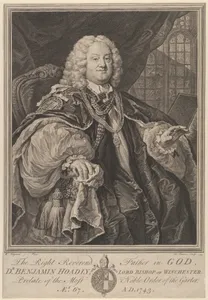
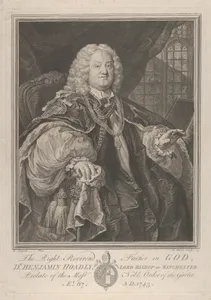
In England, Baron collaborated with leading artists, contributing plates after James Thornhill's dome paintings at St. Paul's Cathedral and, in 1720, assisting Du Bosc and Nicolas Dorigny on Raphael's Hampton Court cartoons. His oeuvre spans reproductive engravings after masters like Rubens, Watteau, Titian, Van Dyck, and Holbein. Highlights include eight plates for Rubens's *Life of Achilles* (1724); four Watteau subjects for Jean de Jullienne's *Recueil Jullienne* (engraved 1729, published 1735), such as *Les Deux Cousines*; and Titian's *Pardo Venus* for Pierre Crozat's collection (published 1742). A key partnership emerged with William Hogarth: Baron engraved plates 2 and 3 of *Marriage à la Mode* (c. 1745), *Evening* from *The Four Times of Day*, and the 1743 portrait of Bishop Benjamin Hoadly—showcasing his precise line work translating Hogarth's satirical vigor into aristocratic appeal. Other notables: Holbein's *Henry VIII Granting the Charter to the Barber-Surgeons' Company* (1736, earning 150 guineas) and multiple Van Dyck portraits.
Married to Grace Lafosse since 1722, with a son Bernard who inherited his plates (later acquired by publisher John Boydell in 1770), Baron featured in Gawen Hamilton's 1735 group portrait *A Conversation of Virtuosis...* and testified before Parliament, aiding the Engravers' Copyright Act. Though critics like Joseph Strutt deemed his style "slight and coarse," Baron's technical skill and cross-channel networks democratized elite art, leaving a legacy in British print culture until his death in London on 24 January 1762.