
Ctrl K
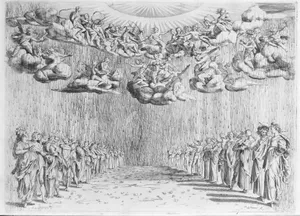
Bernardo Buontalenti, born Bernardo Timante Buonacorsi around 1531 in Florence, was a multifaceted genius of the late Renaissance—Mannerist architect, painter, sculptor, stage designer, military engineer, and pyrotechnics master, earning the nickname "Bernardo delle Girandole" (Bernardo of the Firewheels) for his dazzling fireworks displays. Entering the service of the Medici family as a youth, he remained their devoted artist-engineer for life, embodying the era's blend of art, spectacle, and power. His father, Francesco di Domenico Rosselli, was also an artist, linking Bernardo to Florence's vibrant creative lineage.
Buontalenti's training was extraordinary, spanning the luminaries of Florentine art. He studied painting under Francesco Salviati and Agnolo Bronzino, sculpture under Michelangelo Buonarroti, architecture under Giorgio Vasari, and miniature painting under Giulio Clovio. This rigorous mentorship equipped him for diverse commissions, from delicate miniatures executed for Francesco I de' Medici, son of Cosimo I, to grand architectural feats. Working firmly in the Mannerist tradition, his designs favored elegant complexity, illusionistic effects, and theatricality, influencing the transition toward Baroque exuberance.
Among his major works, Buontalenti orchestrated the lavish 1589 wedding festivities for Grand Duke Ferdinando I de' Medici and Christine of Lorraine, collaborating with artists like Orazio Scarabelli and Epifanio d'Alfiano on prints and decorations that captured floats, fireworks, and ephemeral architecture. He fortified Tuscan cities like Portoferraio on Elba, designed opulent villas and gardens including the Casino Mediceo di Pratolino, and crafted the iconic Buontalenti Grotto in the Boboli Gardens—a Mannerist marvel of rusticated stone, stalactites, and hidden water features symbolizing nature's alchemy. These projects showcased his engineering prowess alongside aesthetic innovation.
Buontalenti's legacy endures as a cornerstone of Mannerist architecture and Medici patronage, shaping Florence's cultural landscape. His integration of art with spectacle and defense prefigured the interdisciplinary artist-engineers of the Baroque, while sites like the Boboli Grotto remain tourist draws, testifying to his enduring ingenuity. He died in Florence in June 1608, leaving an indelible mark on Italy's golden age of design.
(Word count: 348)