Ctrl K
**Christopher Dresser (1834–1904)** was a pioneering British designer and design theorist, widely recognized as one of the first independent industrial designers. Born on 4 July 1834 in Glasgow, Scotland, to a Yorkshire family, he began his formal training at age thirteen at the Government School of Design at Somerset House in London. There he studied applied design and botany, absorbing the principles of leading reformers such as Owen Jones, Richard Redgrave, and Henry Cole.
Dresser’s work spanned wallpapers, textiles, ceramics, glass, furniture, and especially metalwork. He became a central figure in the Aesthetic Movement and helped shape the Anglo-Japanese style, drawing on Japanese aesthetics after his influential 1876–77 visit to Japan as a British government emissary. His designs emphasized functionality, simplicity, and suitability for machine production, rejecting excessive ornament in favor of clean forms inspired by nature and Eastern minimalism.
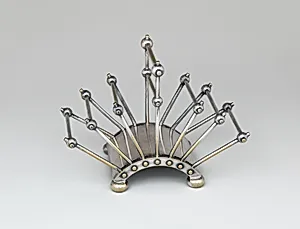
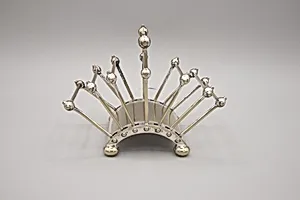
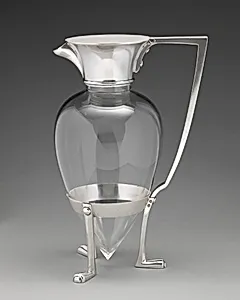
From around 1878 he collaborated closely with the Birmingham firm Hukin & Heath, producing innovative silver and electroplated wares. Notable examples include a toast rack of 1878, a claret jug or decanter of 1879, and a tureen and ladle of 1880. These pieces, often stamped with Dresser’s signature alongside the firm’s mark, exemplify his modern, geometric approach and remain highly prized by collectors. He also designed extensively for other manufacturers, including over a thousand ceramics for Linthorpe Art Pottery.
Dresser authored influential books such as *The Art of Decorative Design* (1862) and *Principles of Decorative Design* (1873), and he lectured widely. His legacy endures as a bridge between Victorian design reform and twentieth-century modernism; many of his metalwork designs continue in production today, and his emphasis on affordable, well-designed objects for industry anticipated the goals of later movements including Art Nouveau and the Arts & Crafts. He died on 24 November 1904 in Mulhouse, Alsace, during a business trip.