
Ctrl K
1700–1786
**Claude Augustin Duflos le Jeune (also known as Claude-Augustin-Pierre Duflos or simply Claude Duflos le Jeune) was a French engraver, printmaker, and architect born in Paris on May 10, 1700, and who died there on February 27, 1786.** He came from a family of engravers; his father, Claude Duflos (1665–1727), served as engraver to the king in Paris, providing him with early exposure to the craft. Duflos worked primarily in Paris and also spent time in the northern Netherlands. He published several collections of prints through his nephew, Pierre Duflos le Jeune, at the Cloître Saint-Benoît near rue Saint-Jacques.
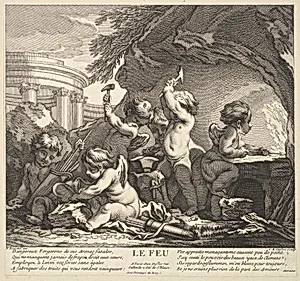
Duflos specialized in etching and engraving, producing refined prints after designs by leading artists of the period, most notably François Boucher. His output included allegorical series such as the Four Elements (*Earth*, *Air*, *Fire*, and *Water*) and depictions of the seasons, as well as mythological and religious subjects. He also created prints after Luca Giordano, including *Hercule et Omphale*. Later attributions link him to erotic illustrations for an edition of Voltaire’s *La Pucelle d’Orléans* (c. 1780), based on drawings by Clément-Pierre Marillier. His style reflects the elegant, decorative qualities of 18th-century French Rococo engraving, emphasizing detail, charm, and narrative clarity.
Among his notable works are reproductive engravings of Boucher’s compositions, such as *Spring* and *Winter*, held in collections like the Metropolitan Museum of Art. Duflos also contributed architectural designs alongside his printmaking. His prints helped disseminate the works of major painters to a wider audience through affordable editions.
Duflos’s legacy endures through his role in preserving and popularizing 18th-century French art via high-quality reproductive prints. His contributions to engraving technique and his family’s multi-generational involvement in the field are documented in historical studies of French printmakers. Today, his works appear in major museum collections, including the Metropolitan Museum of Art, the British Museum, and the National Gallery of Art, where they illustrate the vibrant print culture of Rococo Paris.