
Ctrl K
**Claude Ferdinand Gaillard (1834–1887)** was a French engraver and painter renowned for his innovative techniques and meticulous realism. Born and died in Paris, he became one of the most celebrated engravers of his era through his distinctive approach to line work and detail.
Gaillard received his early training likely from James Hopwood and Lecouturier before studying under his chief master, Léon Cogniet, beginning engraving work with him in 1850. That same year he entered the École des Beaux-Arts. His dedication earned him the Prix de Rome for engraving in 1856. Initially supporting himself with fashion plates, he quickly developed a revolutionary style using soft, delicate parallel lines that avoided crossing, rendering skin textures, wrinkles, and folds with extraordinary precision reminiscent of early Flemish masters like Jan van Eyck. This method shocked contemporaries accustomed to traditional burin techniques.
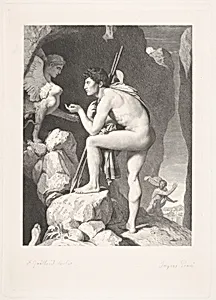
At the 1860 Salon his prints drew criticism for their softness, yet by 1863 his portrait of Bellini in the Salon des Refusés earned high praise from critic Philippe Burty for its “religious care” and classical talent. Gaillard exhibited regularly thereafter, producing both engravings and paintings. Among his major works are the celebrated *L’Homme à l’Oeillet* (The Man with the Carnation, after van Eyck), completed in just eight days; sensitive portraits of Popes Pius IX and Leo XIII; *Saint Sebastian*; and engravings after masters including Bellini, Raphael, and Jean-Auguste-Dominique Ingres (such as *Oedipus and the Sphinx*). He also created a notable *Virgin* after Bellini. As a painter he applied the same exacting, minute style to small canvases that captured character with power and clarity./Claude_Ferdinand_Gaillard)
Gaillard served as teacher to François-Eugène Burney and rose to prominence as president of the Société des Graveurs au Burin in 1886. Decorated in 1876 and made an officer of the Légion d’honneur in 1886, he received a government commission shortly before his death to engrave Leonardo da Vinci’s *Last Supper* and *Mona Lisa*. His insistence that “my aim is not to charm, but to be true; my art is to say all” defined a legacy of uncompromising realism that elevated engraving to new expressive heights.