Ctrl K

1838–1891
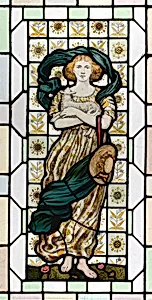
**Daniel Cottier (1838–1891)** was a Scottish artist, designer, and entrepreneur renowned for his pioneering role in the Aesthetic Movement through stained glass, interior decoration, furniture, and ceramics. Born in Anderston, Glasgow, to a seafaring family, he began his training in the 1850s as an apprentice coach painter before advancing to glass painting with firms such as David Keir and John Cairney & Co. in Glasgow, where he encountered the eclectic classicism of architect Alexander “Greek” Thomson. He later worked under James Ballantine in Edinburgh and attended evening classes at the Trustees’ Academy.
In London around 1859, Cottier studied at the Working Men’s College, absorbing the ideas of John Ruskin and receiving instruction from Ford Madox Brown. This placed him near the Pre-Raphaelite circle and the emerging Aesthetic Movement associated with William Morris. Returning to Scotland, he managed Field & Allan before founding his own firm in Edinburgh in 1864. By 1869 he had established Cottier & Co. in London as art furniture makers, mural decorators, and glass and tile painters, later expanding to New York in 1873 and Sydney and Melbourne through partnerships such as Lyon, Cottier & Co.
Cottier’s work blended Pre-Raphaelite figural styles with bold color harmonies, Japanese-inspired motifs, and eclectic ornament drawn from Greek, Gothic, Egyptian, and Assyrian sources. His firm produced notable ecclesiastical and domestic commissions, including windows for churches in Scotland, the United States, and Australia, as well as interiors for architects like William Leiper. He collaborated with or influenced figures such as Louis Comfort Tiffany and John La Farge, and promoted artists including Albert Pinkham Ryder and Matthew Maris while dealing in paintings.
Cottier died of a heart attack in Jacksonville, Florida, in 1891 and is buried in Woodlawn Cemetery, New York. His legacy endures as a key propagator of the Aesthetic Movement across Britain, America, and Australia; his designs and business model shaped later generations of decorators and glass artists, including those associated with the Glasgow Style, and his international firms continued to influence taste well into the twentieth century.