Ctrl K
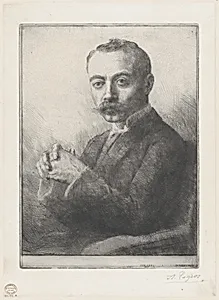
**Alphonse Legros (1837–1911)** was a French-born artist who became a naturalized British citizen and played a pivotal role in the British etching revival as both a practitioner and influential teacher. Born in Dijon on 8 May 1837 to an accountant father, Legros developed an early affinity for rural subjects through visits to relatives’ farms in the region. His training began with an apprenticeship at age eleven to Maître Nicolardo, a house decorator and painter of images in Dijon. In 1851 he moved to Paris, working briefly as a journeyman wall-painter in Lyon before studying scene-painting with Charles-Antoine Cambon and attending the drawing school of Lecoq de Boisbaudran (the “Petite école”), where he formed lasting connections with Jules Dalou and Auguste Rodin. He also took evening classes at the École des Beaux-Arts and taught himself etching around 1857.
Legros aligned with the Realist movement after Gustave Courbet noticed his work at the Paris Salon. Early successes included the profile portrait of his father (accepted at the 1857 Salon) and *Ex Voto* (1861, Musée des Beaux-Arts de Dijon), followed by church interiors such as *L’Angelus*. Encouraged by James McNeill Whistler, he settled in London in 1863, married Frances Rosetta Hodgson the following year, and supported himself through etching and teaching. He later served as professor of etching at the South Kensington School of Art and, from 1876, as Slade Professor at University College London, where his demonstration-based method shaped a generation of artists, including many women known as the “Slade Girls.” He became a British subject in 1881 and remained in England until his death in Watford on 8 December 1911.
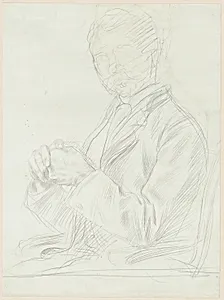
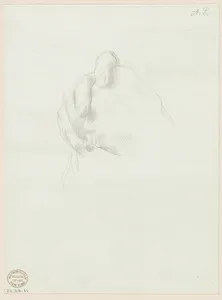
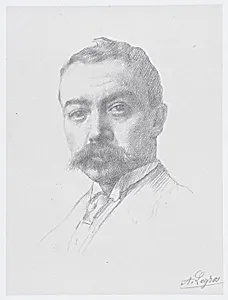
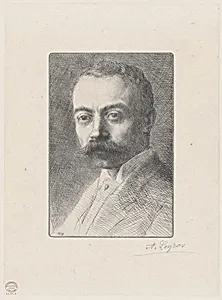
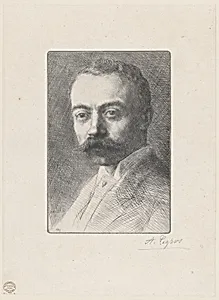
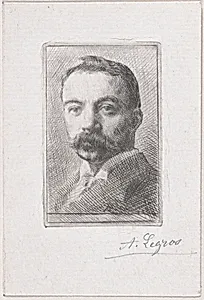
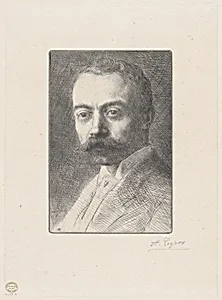
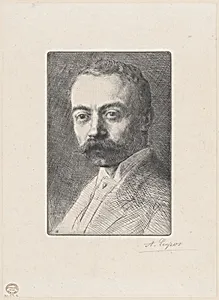
His artistic output spanned painting, etching, sculpture, and medal design, often featuring peasants, landscapes, religious scenes, and penetrating portraits rendered with sober realism and precise line. Notable works include *The Calvary* (1874, Musée d’Orsay), the etching series *The Triumph of Death*, and numerous portraits such as those of Edward Dean Adams, Robert Browning, Edward Burne-Jones, and Auguste Rodin. After resigning his professorship in 1892, he returned to imaginative landscapes and sculptural fountains, including commissions for Welbeck Abbey. Legros’s legacy endures through his contributions to the etching revival, his emphasis on direct observation and outline in teaching, and his influence on British sculpture and medal-making in the Renaissance revival style. His works are held in major collections including the Tate, Victoria and Albert Museum, British Museum, and the Metropolitan Museum of Art.