
Ctrl K
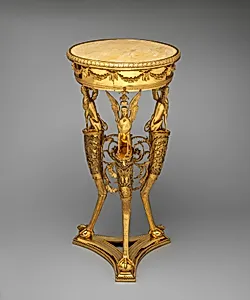
Pierre-Antoine Bellangé (1757/58–1827) stands as one of the preeminent French ébénistes of the late eighteenth and early nineteenth centuries, renowned for his mastery of the Empire style that defined Napoleonic grandeur. Establishing his workshop in Paris on rue Neuve Saint-Denis near the Porte Saint-Denis, Bellangé received his master cabinetmaker title on October 24, 1788. His early commissions included four mahogany chairs in the Gothic style for Count Esterházy, showcasing his versatility before the Revolution's upheavals. By the early 1800s, he had risen to supply the imperial elite, furnishing Marshal Berthier's hôtel particulier on rue Neuve-des-Capucines and secondary residences of Napoleon himself, such as the châteaux of Laeken, Saint-Cloud, Meudon, and Compiègne. In 1811, he was appointed the official Imperial Furniture Warehouse, a testament to his precision in crafting suites of furniture that embodied the era's neoclassical opulence—swans, eagles, and laurel motifs evoking Josephine's influence and imperial might.
Bellangé's work epitomized the Empire style, blending Louis XVI neoclassicism with bolder, monumental forms suited to the First Empire's pomp. His pieces, often in mahogany with gilt bronze mounts, prioritized symmetry, Roman-inspired ornamentation, and functional elegance for state rooms. Notable among his output was a grand salon d'apparat suite commissioned in 1811, exemplifying his role in outfitting Europe's courts, from the Netherlands and Sweden to Denmark. As the patriarch of a dynasty of ébénistes, his sons and relatives continued his legacy through the Restoration and July Monarchy, maintaining the family's prominence in Parisian furniture-making.
Bellangé's influence endures in museum collections worldwide, where his designs inspire reproductions that bridge historical craft with industrial innovation. A striking example is an electrotype table at the Metropolitan Museum of Art, manufactured by the British firm Elkington & Co. of Birmingham (1829–1963), which faithfully recreated one of his originals using pioneering electroplating techniques. This collaboration across eras underscores Bellangé's timeless appeal, transforming bespoke imperial luxury into accessible Victorian metalwork and cementing his status as a cornerstone of decorative arts history.
(Word count: 348)