
Ctrl K
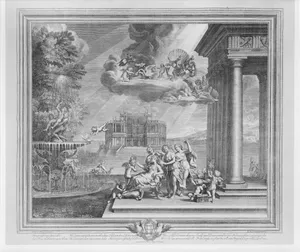
**Étienne Baudet** (c. 1638–1711) was a distinguished French engraver whose career bridged French academic traditions with the rich legacy of Italian Baroque painting. Born in Vineuil in the County of Blois, he trained under the painter Sébastien Bourdon and the engraver Cornelis Bloemaert. He later traveled to Rome, where he absorbed the precise, graver-only technique associated with Bloemaert before returning to Paris and evolving a more versatile style that incorporated the etching needle, bringing his work closer to the refined manner of Jean-Baptiste Poilly.
Baudet specialized in reproductive engravings after leading masters of Italy and France, selecting subjects that showcased both religious and mythological themes with technical elegance. Among his notable plates are several after Francesco Albani, including *The Virgin Teaching the Infant Jesus to Read*, *The Woman of Samaria*, the four-part series *The Loves of Venus and Adonis* (engraved in Rome in 1672), and *The Four Elements* (1695). He also produced important works after Nicolas Poussin—such as *Moses Striking the Rock*, *The Worshipping of the Golden Calf*, and grand landscapes dedicated to the Prince of Condé and the King of France—as well as pieces after Annibale Carracci, Sébastien Bourdon, and Charles Le Brun. These engravings helped disseminate Italian and French compositions across Europe.
Elected a member of the Royal Academy of Painting and Sculpture in Paris, Baudet enjoyed official recognition during his lifetime. His prints, executed with both precision and expressive freedom, remain valued for their fidelity to the originals and their contribution to the visual culture of Louis XIV’s France. Today, his work appears in museum collections worldwide, preserving the compositions of masters like Albani and Poussin for later generations.