
Ctrl K
1803–1847
**J. J. Grandville (Jean Ignace Isidore Gérard, 1803–1847)** was a leading French caricaturist and illustrator whose inventive anthropomorphic imagery and satirical vision made him one of the most influential graphic artists of the nineteenth century. Born in Nancy to an artistic family, he learned drawing from his father, a painter of miniatures, before moving to Paris in 1825 to pursue a career in the graphic arts.
Grandville quickly gained recognition for his sharp political caricatures and whimsical book illustrations. His early success came with the 1829 series *Les Métamorphoses du jour*, which featured humans with animal heads in satirical scenes of contemporary society. He later produced memorable illustrations for Pierre Jean de Béranger’s *Complete Works* (published by Fournier & Perrotin), as well as classics such as *Gulliver’s Travels*, *Robinson Crusoe*, and La Fontaine’s *Fables*. His style blended precise draftsmanship with fantastical transformations, often endowing animals, objects, and flowers with human traits to critique or amuse.
In later years he created ambitious projects such as *Un Autre Monde* (1844) and the posthumously published *Les Fleurs Animées* (1847), works that pushed the boundaries of illustration toward the surreal. Grandville died in Vanves at age forty-three, yet his imaginative approach profoundly shaped later generations, serving as a key precursor to the Surrealist movement and inspiring artists from Gustave Doré to twentieth-century animators.
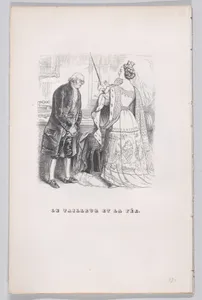
Today his prints and drawings remain celebrated for their wit, technical brilliance, and enduring visual inventiveness. The single work in the museum’s collection—an illustration from Béranger’s volume—exemplifies the lively collaboration between author, publisher, and artist that defined much of his output.
All 1 artworks loaded