
Ctrl K
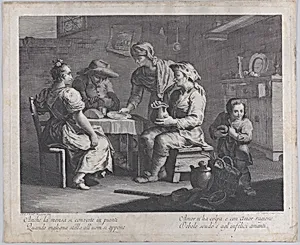
**Friedrich Fleischmann (1791–1834)** was a German painter, graphic artist, and engraver born in Nuremberg. He trained at the city’s Preissler School and studied under A. Gabler, developing skills that positioned him as an important figure in early nineteenth-century printmaking. Fleischmann became one of the first to work extensively in steel engraving, a technique he helped popularize in Germany. His output focused on drawings and prints of contemporary events, historical scenes, and battles, often capturing the spirit of his era with precision and narrative detail.
Fleischmann spent much of his career in Munich after leaving Nuremberg, producing works that ranged from landscapes and architectural views to reproductive prints after earlier masters. One notable example is his drawing after Correggio’s *Holy Family with Saint John the Baptist*. His engravings and etchings, including views such as *The Golden Bear Inn, Former Home of Hans Sachs in Nuremberg*, demonstrate a keen eye for historical atmosphere and architectural accuracy.
Though less celebrated today than some of his Romantic contemporaries, Fleischmann’s technical innovations in steel engraving and his dedication to both original compositions and faithful reproductions left a mark on German graphic arts. His works are held in collections including the Metropolitan Museum of Art and the Cincinnati Art Museum, where they continue to illustrate the transition from eighteenth-century traditions to the more industrialized print culture of the nineteenth century.
**Antonio Allegri da Correggio (c. 1489–1534)**, known simply as Correggio, was the foremost painter of the Parma school during the High Renaissance. Born in the small town of Correggio near Reggio Emilia to a merchant family, he likely received initial instruction from his uncle, the local painter Lorenzo Allegri. He probably studied in Modena and spent time in Mantua, where he absorbed the influence of Andrea Mantegna before the latter’s death in 1506. Correggio’s early works show a command of perspective, anatomy, and optics that belies any notion of him as self-taught.
Correggio developed a distinctive style marked by luminous chiaroscuro, dynamic compositions, dramatic foreshortening, and an atmospheric softness that anticipated both Baroque and Rococo art. He became celebrated for illusionistic frescoes, most famously the *Assumption of the Virgin* in the dome of Parma Cathedral (1526–1530), as well as altarpieces and mythological scenes. His sensuous handling of light and form influenced later artists, notably Parmigianino.
Although he remained based in his native region and never achieved the international fame of contemporaries like Raphael or Michelangelo during his lifetime, Correggio’s innovative approach to ceiling decoration and emotional expressiveness secured his lasting legacy. Today he is recognized as one of the most original and forward-looking painters of the Italian Renaissance, with major works in collections such as the National Gallery in London and the Prado.