
Ctrl K
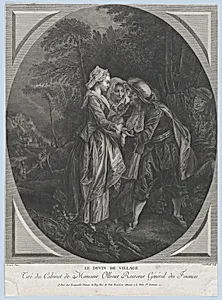
**François Jourd'heuil (1759–1781)** was a French engraver born in Poitiers and active in Paris, where he died at the remarkably young age of 22. Little is known about his early life or formal training, as records from this period are sparse for reproductive printmakers of his generation. By his early twenties, however, Jourd'heuil had established himself in the vibrant Parisian art scene, specializing in detailed engravings that faithfully reproduced the compositions of established painters. His work exemplifies the late Rococo tradition of meticulous copperplate engraving, characterized by fine lines, subtle tonal gradations, and a focus on pastoral and mythological themes popular in 18th-century France.
Jourd'heuil's known oeuvre includes reproductive prints after prominent artists, showcasing his skill in translating oil paintings into print form. A standout example is *The Village Soothsayer* (1762), an etching after Gabriel Briard (1725–1777), depicting rustic figures in a lively rural scene with a sense of everyday enchantment. He also engraved *Mercury and Herse*, faithfully capturing Laurent de La Hyre's 17th-century mythological narrative of the god's pursuit. Another work, *La faiseuse de choux-croute* (c. 1774–1781), held in the Statens Museum for Kunst, highlights his interest in genre scenes of domestic life. These pieces demonstrate his technical precision and ability to convey texture—from foliage to fabric—in the reproductive print tradition that made art accessible beyond original canvases.
Though his career was tragically brief, Jourd'heuil contributed to the dissemination of French painting through his engravings, bridging the gap between painters like Briard—a history and landscape artist trained under Charles-Joseph Natoire, Prix de Rome winner (1749), and Académie member (1768)—and a wider audience. Briard's pastoral compositions, such as the source for *The Village Soothsayer*, found new life in Jourd'heuil's hands, preserving their charm in museum collections today. His early death curtailed further output, but surviving prints underscore the vital role of engravers in 18th-century European art, ensuring the legacy of Rococo elegance endures in etched lines.