
Ctrl K
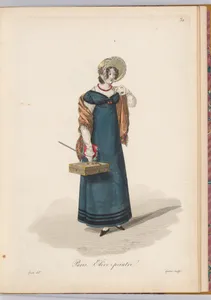
**Georges-Jacques Gatine (ca. 1773–after 1841) and Louis-Marie Lanté (1789–1839 or later)** formed one of the most productive partnerships in early nineteenth-century French fashion and costume illustration. Gatine, born in Caen, worked primarily as an engraver and etcher, while Lanté served as the principal designer and draftsman. Their collaboration produced hundreds of hand-colored plates documenting contemporary Parisian dress, regional costumes, and historical attire, capturing the shifting styles of the Napoleonic era through the July Monarchy.
Lanté trained under the architect and painter Antoine Vaudoyer and exhibited regularly at the Paris Salons from 1824 to 1838, earning a silver medal at Lille in 1825. He specialized in watercolor designs for fashion plates and became the most prolific contributor to Pierre de La Mésangère’s influential *Journal des Dames et des Modes*, supplying roughly 1,466 drawings between 1814 and 1837. Gatine translated these designs into engravings with remarkable precision and flair, often adding lively satirical touches.
Their most celebrated joint project was the series *Le Bon Genre* (1800–1822), whose witty depictions of “Incroyables et Merveilleuses” satirized fashionable society and later inspired artists such as Honoré Daumier. Gatine also engraved Lanté’s designs for regional costume suites, including *Costumes des femmes du Pays de Caux* and *Costumes des départements de la Seine-Inférieure*, as well as historical compilations such as the *Galerie française de femmes célèbres* (1827). Additional works include *Collection de Travestissements de Toutes les Nations* and plates for *Les Ouvrières de Paris*.
Together, Gatine and Lanté left an invaluable visual archive of French fashion and social life. Their elegant, meticulously colored engravings remain prized by museums and collectors for both their artistic quality and their documentary value, preserving the ephemeral details of dress, coiffure, and deportment that defined an era.