
Ctrl K
1803–1884
**Adrian Ludwig Richter (1803–1884)** was a leading German painter, etcher, and illustrator whose work embodied the Romantic and Biedermeier traditions of the nineteenth century. Born on September 28, 1803, in Friedrichstadt, Dresden, he was the son of the engraver Carl August Richter, who provided his initial artistic training. Strongly influenced by the graphic artists Daniel Chodowiecki and Johann Christoph Erhard, Richter developed a distinctive style that blended detailed landscape elements with narrative figure scenes, evoking the homely charm of German fairy tales.
Richter traveled to Italy from 1823 to 1826, where he absorbed classical and picturesque motifs, though he later focused primarily on German subjects. He worked as a designer for the Meissen porcelain factory between 1828 and 1836 and, in 1841, was appointed professor and head of the landscape atelier at the Dresden Academy. His paintings often merged figures seamlessly with their surroundings, as seen in notable works such as *Harvest Procession in the Campagna* (1833), *Ferry at the Schreckenstein* (1836), *View of the Riesengebirge* (1839), and the celebrated *Bridal Procession in a Spring Landscape* (1847) in the Dresden Gallery. He also produced around 240 etchings, many depicting views of Saxony, and thousands of drawings.
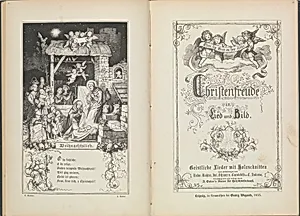
Richter achieved his greatest fame as an illustrator, creating woodcuts and designs for numerous books, including editions of the Brothers Grimm fairy tales, *The Vicar of Wakefield* (1841), Musäus’s *Volksmärchen der Deutschen* (1842), and cyclical publications such as *Kinderleben* (1852) and *Unser täglich Brot* (1866). These works captured the spirit of mid-nineteenth-century German domesticity and imagination. An eye disease ended his active career in 1874; he retired in 1877 and died on June 19, 1884, in Loschwitz near Dresden. His autobiography, *Lebenserinnerungen eines deutschen Malers*, was published posthumously, and he remains celebrated for his quintessential German illustrations and his influence on later artists, including protégé Hermann Lungkwitz.