
Ctrl K
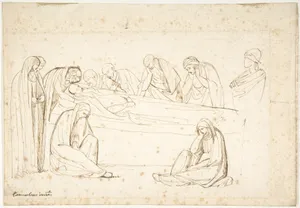
**George Romney (1734–1802)** was a leading English portrait painter of the late 18th century, renowned for his elegant depictions of fashionable society figures. Born on 26 December 1734 in Dalton-in-Furness, Lancashire (now Cumbria), as the third son of a cabinetmaker, he showed early talent for drawing and woodwork.)
His formal training began in 1755 with a four-year apprenticeship in Kendal to the portraitist Christopher Steele, who had studied under the French artist Carle Vanloo. After marrying Mary Abbot in 1756 and briefly working locally, Romney moved to London in 1762 to build his career, though he maintained financial support for his family back in the north.)
Romney developed a distinctive style focused on graceful, idealized portraits that captured the elegance of Georgian high society. He avoided the more psychological depth favored by contemporaries like Sir Joshua Reynolds and instead emphasized fluid brushwork, luminous color, and flattering compositions. Never a member of the Royal Academy, he exhibited successfully at other venues and gained prominence through commissions from aristocrats and intellectuals. A pivotal journey to Italy from 1773 to 1775 allowed him to study Raphael and other Old Masters in Rome, refining his technique upon his return.
His most celebrated works include numerous portraits of Emma Hamilton—his artistic muse and the mistress of Lord Nelson—whom he depicted more than sixty times in mythological and historical guises, such as *Lady Hamilton as Circe* (c. 1782). Other notable paintings feature society sitters like *Portrait of Lady Anne de la Pole* (1786) and historical subjects such as *The Death of General Wolfe*.)
Romney’s legacy endures as one of Britain’s foremost portraitists of his era, alongside Reynolds and Thomas Gainsborough. His works are held in major collections worldwide, including the National Portrait Gallery in London and the Metropolitan Museum of Art in New York, where they continue to exemplify the refined aesthetic of 18th-century British art. He spent his final years in Kendal, where he died on 15 November 1802.
All 1 artworks loaded