Ctrl K
**Alfred Welles (1783–1869)** was an American silversmith active in Boston, Massachusetts, during the early nineteenth century. Born in 1783, his early life remains sparsely documented, though records indicate he worked initially in Hebron, Connecticut, before establishing himself in Boston around 1804–1806. He is frequently associated with George Welles (1784–1823), with whom he collaborated on silver objects; the two appear together as makers on surviving pieces, suggesting a partnership or familial connection in the trade. Welles also served as a general during the War of 1812, reflecting the civic roles often taken by artisans of his era.
Welles worked in the tradition of Federal-era American silver, producing functional yet elegantly proportioned domestic wares typical of Boston craftsmanship. His output reflects the refined neoclassical tastes of the period, emphasizing clean lines, balanced forms, and subtle ornamentation suited to the homes of the emerging American merchant class. No formal artistic training or mentors are recorded; like many silversmiths of the time, he likely learned the craft through apprenticeship within the local metalworking community.
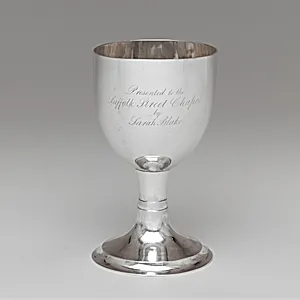
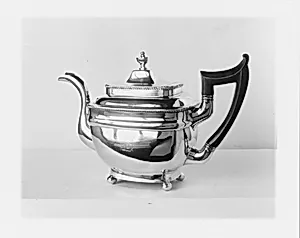
Among his documented works are a silver cann (tankard) and a teapot, both dated circa 1810 and made in Boston in partnership with George Welles. These pieces, now in the collection of the Metropolitan Museum of Art, exemplify the high quality of early American silver. The cann, for instance, features a sturdy yet graceful profile with a capacity suited for everyday use or ceremonial purposes.
Welles’s legacy endures through these preserved examples of Boston silver, which offer valuable insight into the material culture and artisanal skill of the young republic. His contributions, alongside those of his collaborator George Welles, help document the transition from colonial to Federal styles in American metalwork, ensuring that the refined craftsmanship of early nineteenth-century Boston remains accessible to modern audiences.