
Ctrl K
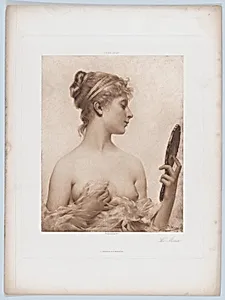
**Jules-Charles Aviat (born Jules-Charles Mauperrin, 1844–1931)** was a French academic painter renowned for his elegant portraits and historical subjects. Born in Brienne-le-Château in the Aube department, he later adopted the surname Aviat from his stepfather following his mother’s remarriage. His early interest in art was sparked by his step-uncle, the landscape painter and photographer Auguste Louis Aviat.
Aviat trained in Rome from 1867 to 1870 at the Académie de France à Rome under director Ernest Hébert, who provided guidance and became a friend and mentor. Upon returning to France, he studied with Jules-Isidore Lafrance, Carolus-Duran, and especially Léon Bonnat. He worked in the academic tradition, excelling in refined portraiture—particularly of women and children—while also producing mythological scenes and history paintings. His style blended detailed accessories reminiscent of Winterhalter with the graceful charm associated with Gainsborough, often featuring luminous faces against neutral backgrounds in the manner of Bonnat.
Aviat exhibited regularly at the Paris Salon from 1876 to 1924 and participated in major international expositions, including the 1900 Paris Universal Exhibition. He contributed to the decoration of the Panthéon in Paris alongside Bonnat, Hébert, and Puvis de Chavannes. Notable works include *Charlotte Corday and Marat* (1880, Musée des Beaux-Arts de Rouen) and numerous society portraits, such as those of Adelina Patti and various American sitters. In 1905–1906 he traveled to Louisville, Kentucky, at the invitation of the Ballard family, painting several prominent local figures before visiting New York; his works were also reproduced by publishers such as Goupil & Co. and D. Appleton & Co.
In later years Aviat settled in Périgueux, where he continued painting regional notables and landscapes; the local Musée d’art et d’archéologie du Périgord holds several of his paintings. He left a legacy of polished, accessible academic portraiture that bridged 19th-century traditions with early 20th-century tastes, with examples preserved in public collections across France.