
Ctrl K
**Hasegawa Myōtei: Master of Nyohitsu Calligraphy**
Hasegawa Myōtei (長谷川妙躰, also rendered as 妙貞), a pioneering female calligrapher of Japan's Edo period, flourished in the late 17th and early 18th centuries. Her early life remains not well documented, with no confirmed records of formal training or specific teachers, though she hailed from Kyoto and belonged to a family lineage skilled in the arts: her father-in-law was a calligrapher, his father a painter, and his father another calligographer. Active primarily in Osaka and Kyoto, Myōtei rose to prominence under the pseudonym Hikkaishi (筆海子), producing woodblock-printed calligraphy manuals that catered to the growing literacy among urban women.
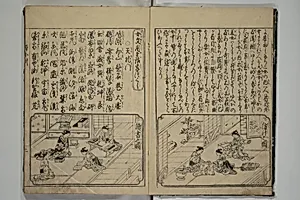
Myōtei worked in the nyohitsu (女筆, "women's brush") tradition, revolutionizing it with her signature kakichirashi ("scattering writing") style. This innovative approach featured unevenly sized characters scattered diagonally across the page, intricate ligatures forming rhythmic lines, extended harai hooks for feminine delicacy, and fluid leftward or upward flourishes—departing from orthodox forms to emphasize aesthetic playfulness. Often collaborating with figures like Nakamura Sankinshi (中村三近子, 1671–1741), an illustrator and author, she created primers blending model letters with seasonal motifs, such as New Year's greetings or ceremonial thanks. Key works include *Naniwazu* (難波津, 1714), a celebrated album of poetic calligraphy held at the Metropolitan Museum of Art; *Nyohitsu shinan shū* (女筆指南集, ca. 1734), paired with illustrations attributed to Nishikawa Sukenobu; and the rare *Nyohitsu kasugano shita* (女筆嘉須賀濃下, 1730), featuring winter-to-spring epistles. Her output totaled around 20 such ehon (picture books), outpacing contemporaries.
Myōtei's legacy endures as the spark of a mid-Edo nyohitsu boom, captivating chōnin (townswomen) who prized her unconventional elegance over samurai rigidity. Compared to Ono Otsū, she democratized sophisticated letter-writing, fostering self-expression amid rising female education. Though sometimes noted as a painter, her enduring impact lies in transforming calligraphy into an accessible, visually poetic art form that bridged literature and civility manuals. Her primers, blending beauty and practicality, reflect the vibrant cultural shifts of Genroku-era Japan.
No artworks found for this artist