Henry Ary (ca. 1807–1859) was an American painter whose life and career remain sparsely documented, with few surviving records illuminating his early years or personal background. Born around 1807, likely in the northeastern United States, Ary worked during the formative period of American landscape painting in the mid-19th century. Details of his training, teachers, or formal art school affiliations are not well documented in available sources, suggesting he may have been a self-taught or regionally trained artist operating outside major urban centers like New York or Philadelphia.
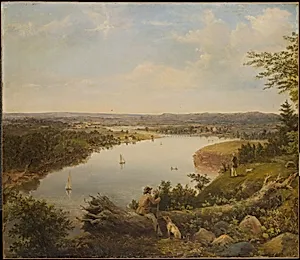
Ary specialized in landscapes, capturing the natural beauty and everyday scenes of American locales with a straightforward, observational style. One of his known works, *View of Hudson, New York* (preserved in collections accessible via Google Arts & Culture), depicts the Hudson River Valley town with meticulous attention to topography, architecture, and atmospheric light, evoking the regionalist spirit that influenced early American art. Auction records from sites like MutualArt, Invaluable, and Artnet indicate a modest oeuvre of similar landscapes and possibly genre scenes, though specific dated works beyond this are scarce. His paintings reflect the pre-Hudson River School era, prioritizing topographic accuracy over romantic sublimity, aligning with itinerant artists who documented expanding American frontiers.
Though Ary's legacy is overshadowed by contemporaries like Thomas Cole or Asher B. Durand, his contributions persist in the auction market and institutional collections, where his views offer valuable glimpses into 19th-century Hudson Valley life. Today, works attributed to Ary occasionally surface at fine art sales, underscoring his role as a minor but authentic voice in the development of American realism. Further archival research may yet uncover more about this elusive figure, enriching our understanding of the diverse practitioners shaping the nation's visual identity. (312 words)
