
Ctrl K
1632–1723
**Sir Christopher Wren (1632–1723)** was a towering figure in British architecture, renowned for his mastery of the English Baroque style and his pivotal role in rebuilding London after the Great Fire of 1666. Born in East Knoyle, Wiltshire, on 20 October 1632, Wren was the only surviving son of a clergyman who later became Dean of Windsor. He received his early education at home and briefly at Westminster School before entering Wadham College, Oxford, in 1650, where he studied Latin, Aristotelian physics, and mathematics. His intellectual circle at Oxford, centered around John Wilkins, profoundly shaped his scientific and creative outlook, leading to his election as a Fellow of All Souls and his later prominence as a founder of the Royal Society, which he served as president from 1680 to 1682.
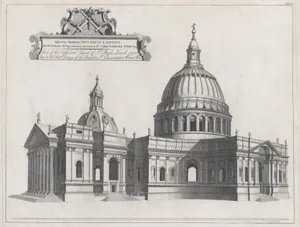
Although primarily celebrated as an architect, Wren’s designs were brought to life through collaboration with skilled draughtsmen and engravers. Nicholas Hawksmoor served as a key draughtsman in his office, while engravers including Henry Hulsbergh (Dutch-born, active in London from at least 1709 until his death in 1729), Simon Gribelin II, John Vanderbank the younger, Jacob Schijnvoet, and Benjamin Cole translated his architectural visions into print. Their collective efforts produced the notable *A Catalogue of the Churches of the City of London*, documenting Wren’s ecclesiastical projects. Wren himself trained in drawing during his Oxford years and applied these skills to anatomical illustrations and architectural plans, though he had no formal apprenticeship in the visual arts.
Wren’s major works include the rebuilding of 52 City churches and his masterpiece, St Paul’s Cathedral, completed in 1710. Other significant buildings encompass the Royal Hospital Chelsea, the Old Royal Naval College at Greenwich, and the south front of Hampton Court Palace. Appointed Surveyor of the King’s Works in 1669, he oversaw these projects in a distinctive Baroque idiom that blended classical proportions with inventive spatial drama. He was knighted in 1673 and served multiple terms in Parliament.
Wren’s legacy endures as one of England’s greatest architects; his scientific contributions were admired by contemporaries such as Isaac Newton, and his buildings continue to define London’s skyline. He died on 25 February 1723 (O.S.) and was buried in St Paul’s Cathedral, the ultimate monument to his genius. The collaborative prints of his oeuvre, featuring the work of Hulsbergh and his fellow engravers, preserve his designs for posterity and highlight the collaborative nature of architectural production in his era.
No artworks found for this artist