Ctrl K
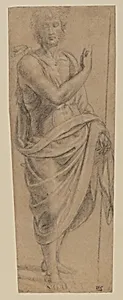
**Innocenzo di Pietro Francucci da Imola** (c. 1490 – c. 1550), commonly known as Innocenzo da Imola, was an Italian Renaissance painter and draftsman active primarily in Bologna. Born in Imola as the son of a goldsmith named Pietro, he began his artistic training locally before moving to Bologna around 1506. There, he is recorded as entering the studio of Francesco Francia in 1508. By 1510 he had traveled to Florence, where he worked under the direction of Mariotto Albertinelli.
His artistic style blended Bolognese color sensibilities with Florentine attention to form and composition, often adopting a Raphaelesque manner in his religious subjects. He specialized in altarpieces, devotional panels, and frescoes for churches, with his earliest securely dated works including *The Virgin and Child with Saints Sebastian, Roch, Cosmas and Damian* (1515) and *The Virgin and Child with Saints John, Apollinaris and Catherine and a Bishop* (1516). Among his notable later pieces are *The Virgin and Child with Saints John the Baptist, Peter and Paul, Joachim and Anne* (1526) in Faenza Cathedral, *The Virgin of the Rosary* (1531), and *The Mystical Marriage of Saint Catherine* now in the Filangieri Museum, Naples. His only known secular works are a series of five mythological frescoes in Bologna’s Palazzina della Viola.
Innocenzo trained several prominent artists, including Francesco Primaticcio, Prospero Fontana, and Pietro Lamo, thereby influencing the next generation of Emilian painters. He remained based in Bologna for most of his career, contributing frescoes and altarpieces to local churches such as Santa Maria dei Servi. He died in Bologna around 1550. His legacy lies in bridging Florentine and Bolognese traditions during the High Renaissance, producing refined religious imagery that continued to be appreciated in Emilian collections.