
Ctrl K
1809–1874
**Owen Jones (1809–1874)** was a British architect, designer, and one of the most influential design theorists of the nineteenth century. Born in London on 15 February 1809, he trained at the Royal Academy Schools and developed a deep interest in ornament and polychromy through extensive travels in the Near East and Spain between 1833 and 1834. His early work focused on Islamic architecture, culminating in the detailed publication *Plans, Elevations, Sections and Details of the Alhambra* (1842–45), which brought renewed attention to Moorish design principles in Britain.)
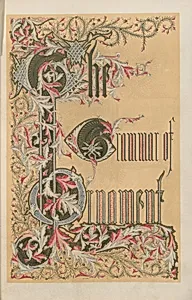
Jones played a central role in the Great Exhibition of 1851 and later contributed to the interior decoration and color schemes of the Crystal Palace at Sydenham in 1854. His most enduring achievement is *The Grammar of Ornament* (1856), a groundbreaking systematic study of decorative motifs from around the world that emphasized color, proportion, and the logical application of historical styles to modern design. The 1868 edition, published by Bernard Quaritch Ltd., featured contributions from artists and scholars including J. B. Waring, J. O. Westwood, and Matthew Digby Wyatt. Jones also worked as an interior decorator, book illustrator, and pioneer of prefabricated metal structures.
Throughout his career, Jones championed a rational approach to ornament that drew equally from Eastern and Western traditions, rejecting mere historicism in favor of principles adaptable to industrial production. He died in Westminster on 19 April 1874. His ideas profoundly shaped Victorian design education and continue to influence pattern-making, graphic design, and architectural ornament today, with *The Grammar of Ornament* remaining a foundational reference in art and design history.