
Ctrl K
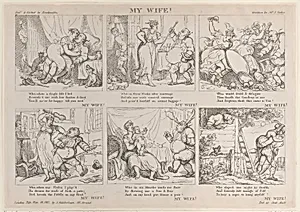
**Thomas Rowlandson (1757–1827)** was a leading English artist and caricaturist of the Georgian era, celebrated for his sharp political satire, lively social observation, and prolific output in prints, watercolors, and book illustrations. Born on 13 July 1757 in London’s Old Jewry to William and Mary Rowlandson, he grew up amid financial hardship after his father’s bankruptcy. An inheritance from his aunt enabled his artistic pursuits, and he quickly demonstrated talent for humorous drawing even as a schoolboy at the Soho Academy.
Rowlandson trained at the Royal Academy Schools in London after a brief period in Paris around age 16, where he may have studied under sculptor Jean-Baptiste Pigalle. He spent about six years at the Academy, exhibiting early works and earning a silver medal. His style blended delicate line work with vibrant washes, often etched and hand-colored, drawing influences from Thomas Gainsborough, Peter Paul Rubens, James Gillray, and Henry William Bunbury. He excelled in both refined topographical scenes and robust, sometimes bawdy caricatures targeting figures like the Duchess of Devonshire, William Pitt the Younger, and Napoleon.
Among his major achievements are the popular *Dr. Syntax* series (beginning with *The Tour of Dr. Syntax in Search of the Picturesque* in 1812, in collaboration with writer William Combe and publisher Rudolph Ackermann), the *English Dance of Death* (1815–16), and illustrations for authors such as Smollett, Goldsmith, and Sterne. Iconic individual works include *Vauxhall Gardens* (c. 1784) and numerous depictions of London street life, pleasure gardens, elections, and medical themes. He also produced private erotica and developed the character of John Bull in satirical contexts.
Rowlandson’s legacy endures as one of the foremost caricaturists of his time, admired for his fluid draughtsmanship and keen commentary on Georgian society. His works, widely disseminated through prints, influenced later generations of illustrators and remain prized in museum collections for their humor, vitality, and historical insight. He died in London on 21 April 1827.