
Ctrl K
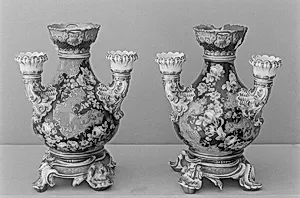
**Jacob Petit (1796–1865), born Jacob Mardouché in Paris, was a leading French porcelain manufacturer and decorator of the nineteenth century.** He adopted the surname Petit from his wife, Anne Adelaïde Petit, and began his artistic training by studying painting in the studio of the neoclassical master Antoine-Jean Gros. He gained early experience as a painter at the renowned Sèvres porcelain factory before embarking on travels across Italy, Switzerland, Germany, and England, where he studied local industries and even painted theater scenery.
Upon returning to France around 1830–1831, Petit established himself as a porcelain manufacturer. He acquired the former Baruch Weil factory in Fontainebleau in 1833 (sometimes referred to in connection with royal traditions), opened a decorating workshop in Paris, and later expanded operations to Avon. His production shifted from tableware to purely ornamental hard-paste porcelain pieces, including vases, clocks, perfume burners, candelabra, figurines, and statuettes. These works are celebrated for their exuberant Rococo revival style—marked by asymmetrical forms, lavish relief decoration with flowers, scrolls, birds, and foliage, vibrant polychrome palettes, and generous gilding—drawing inspiration from Meissen, Saxon traditions, and eclectic historical motifs (Gothic, Renaissance, Neoclassical, and Eastern).
Petit’s factory became one of the most successful and prolific in France during the 1830s–1860s, earning awards at industrial exhibitions and universal expositions for technical innovation and design. His pieces appealed strongly to the emerging bourgeois market with their opulent, romantic fantasy and accessible splendor. Though he sold many undecorated “blanks” to other decorators, his own output remains instantly recognizable for its imaginative exuberance. Petit’s legacy endures in museum collections and the continued appreciation of his role in revitalizing French decorative porcelain during the Romantic era.
No artworks found for this artist