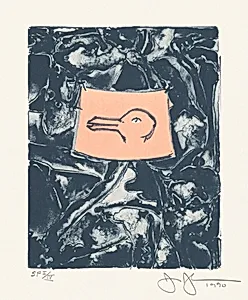
Jasper Johns (born May 15, 1930) is an American painter, sculptor, draftsman, and printmaker whose revolutionary work fundamentally transformed the trajectory of postwar American art. Emerging in the 1950s when Abstract Expressionism dominated the New York art world, Johns introduced a radically different approach by painting familiar, everyday symbols—flags, targets, numbers, and maps—that he described as 'things the mind already knows.' His innovative use of encaustic, combined with his incorporation of collaged newspaper and three-dimensional objects, created richly textured surfaces that challenged conventional distinctions between painting and sculpture, representation and abstraction. Born in Augusta, Georgia, Johns experienced a fragmented childhood, living with various relatives across South Carolina after his parents' divorce. This early instability would later inform the autobiographical elements that emerged in his mature work. After briefly studying art at the University of South Carolina and serving in the Korean War, Johns settled in New York in 1953, where he met Robert Rauschenberg and began the artistic partnership that would help define Neo-Dada and pave the way for Pop Art. His 1958 solo debut at Leo Castelli Gallery caused an immediate sensation, with the Museum of Modern Art's director Alfred Barr acquiring four works from an unknown 28-year-old artist—an unprecedented move that signaled Johns's arrival as a major force in contemporary art. Over seven decades, Johns has continually reinvented his practice while maintaining an intense focus on perception, semiotics, and the nature of representation itself. From his iconic flag and target paintings of the 1950s through his crosshatch works of the 1970s to his increasingly autobiographical explorations in recent decades, Johns has created a body of work that bridges Abstract Expressionism, Neo-Dada, Pop Art, Minimalism, and Conceptual Art. His influence on subsequent generations of artists is immeasurable, and he remains arguably the most significant living American artist, having received every major honor including the Presidential Medal of Freedom in 2011.
Jasper Johns was born on May 15, 1930, in Augusta, Georgia, though the hospital location was merely a matter of proximity—his parents were living in Allendale, South Carolina, where his father William Jasper Johns worked as a farmer and former lawyer. Johns's early childhood was marked by instability and displacement. After his parents divorced when he was only three years old, he lived with his paternal grandparents in Allendale, then spent a year with his mother and stepfather in Columbia, South Carolina, and subsequently lived with his Aunt Gladys on Lake Murray, twenty-two miles from Columbia. This pattern of moving between relatives in Allendale, Columbia, Batesburg, and Sumter would profoundly shape Johns's sense of identity and later emerge as a recurring theme in his autobiographical works.
Despite having minimal exposure to art in rural South Carolina, Johns knew from the age of three that he wanted to be an artist and began drawing early. He excelled academically, graduating as valedictorian from Edmunds High School in Sumter in 1947. Following graduation, he briefly attended the University of South Carolina, studying art for three semesters before making the pivotal decision to move to New York City. There, he enrolled at Parsons School of Design in 1949, but his education was interrupted when he was drafted into the U.S. Army during the Korean War. He served for two years, spending much of his service stationed in South Carolina and Japan. This period away from the art world proved to be a crucial interlude, allowing Johns to develop his ideas in relative isolation before his triumphant return to New York in 1953, where his mature artistic vision would soon crystallize.
Upon returning to New York in 1953, Johns worked at the Marlboro bookstore while attempting to establish himself as an artist. The defining moment of this period came when he met Robert Rauschenberg through mutual friend Suzi Gablik during the 1953-54 holiday season. The two artists, who were five years apart in age, quickly formed a deep intellectual, artistic, and romantic partnership. This relationship occurred during an era of intense homophobia in America, forcing them to keep their bond largely hidden from the public eye. They lived and worked in adjacent studios on Pearl Street, creating a private creative sanctuary where they engaged in constant dialogue and mutual critique. As Rauschenberg famously stated, 'We gave each other permission'—permission to break away from the dominant Abstract Expressionist aesthetic and forge a new artistic direction. To support themselves, they collaborated on commercial projects including window displays for Fifth Avenue department stores, working under pseudonyms to protect their reputations as avant-garde artists.
In late 1954, Johns made the decisive break that would define his career. After having a dream of the American flag, he destroyed nearly all the artwork he had created up to that point, declaring it was time 'to stop becoming and to be an artist.' He began creating the paintings that would make him famous: depictions of flags, targets, numbers, letters, and maps. These works employed encaustic, a fast-drying mixture of pigment suspended in warm wax, which Johns chose because it dried quickly while keeping brushstrokes distinct. He painted the encaustic onto strips of newspaper that were adhered to canvas, creating thick, impasto-like surfaces that emphasized the physicality of the painting as object. His first Flag (1954-55), painted in encaustic, oil, and collage on fabric mounted on plywood in three panels, represented a radical departure from Abstract Expressionism's emphasis on individual expression. In March 1957, gallery owner Leo Castelli visited Rauschenberg's studio and asked to see Johns's work. Descending one floor, Castelli encountered what he later described as 'a fantastic display of flags and targets.' Johns's first solo exhibition at Leo Castelli Gallery in January 1958 hit the art world 'like a meteor,' in the words of New Yorker critic Calvin Tomkins. Alfred Barr, director of the Museum of Modern Art, made the unprecedented decision to acquire four works from this unknown artist's debut show, though he could not convince the MoMA trustees to directly purchase Flag due to fears of patriotic backlash during the Cold War. Architect Philip Johnson instead bought the work and later donated it to the museum in 1973. The 1958 show was a sensation—all but two of the eighteen works sold—and Johns, at age 28, became an overnight art world phenomenon.
Following his explosive debut, Johns continued to develop his distinctive visual language while expanding into sculpture. In 1958, he created his first sculpture, Flashlight I, modeling it from Sculp-metal, a pliable metallic medium that could be manipulated like paint or clay. His sculptural work reached a pinnacle with Painted Bronze (Ale Cans) (1960), consisting of two individually cast bronze beer cans painted to look remarkably realistic—one open, one closed—set on a fabricated base. According to legend, the work originated from Abstract Expressionist Willem de Kooning's sarcastic remark about dealer Leo Castelli: 'Give that son-of-a-bitch two beer cans and he could sell them.' Johns also created Painted Bronze (Savarin) (1960), a bronze cast of a Savarin coffee can filled with paintbrushes. These sculptures violated traditional notions about being 'true to materials' by casting bronze and then painting it to mimic common objects, effectively liberating other artists from such constraints.
During this period, Johns created some of his most iconic paintings. Three Flags (1958) superimposed three canvases in apparent reverse perspective, projecting toward the viewer in a radical spatial configuration. The Whitney Museum acquired this work in 1980 for one million dollars, a groundbreaking price that underscored its significance. Map (1961), a large oil painting measuring over ten feet wide, was given to Johns by Rauschenberg as a schematic American map from a school notebook; Johns painted over it and used those proportions to create this monumental work, complete with stenciled state names and prominent paint drips. Johns also developed his target series extensively during these years, including Target with Four Faces (1955), which featured a hinged wooden box containing four tinted-plaster faces mounted above the painted target, forcing viewers to examine the relationship between the anonymous faces and the act of targeting itself. In the early 1960s, Johns began incorporating references to poets who resonated with him personally. Diver (1962-63), divided into two panels that bisect the image vertically, was dedicated to Hart Crane, the American poet who committed suicide in 1932 by jumping from a ship into the ocean. Other works like In Memory of My Feelings (1961) paid homage to poet Frank O'Hara, revealing Johns's deep engagement with literature and his growing interest in memorial and autobiographical themes. In 1961, Johns and Rauschenberg's romantic relationship ended bitterly over professional, aesthetic, and personal conflicts. The breakup was so painful that both artists left New York for extended periods and barely spoke for the next decade. Despite this rupture, their collaboration had fundamentally altered the course of contemporary art, establishing Neo-Dada and laying the groundwork for Pop Art.
The 1970s marked a significant shift in Johns's work as his compositions became increasingly abstract. Beginning with his painting Untitled (1972), Johns developed a new motif of crosshatched lines that would dominate his work for over a decade. According to the artist, the inspiration came from a fleeting glimpse of a pattern on a car that passed him on a highway: 'I only saw it for a second, but knew immediately that I was going to use it. It had all the qualities that interest me—literalness, repetitiveness, an obsessive quality, order with dumbness, and the possibility of a complete lack of meaning.' Johns worked almost exclusively with this motif from 1972 to 1983, creating increasingly complex systems that experimented with colors, patterns, mirroring, and reversals.
The crosshatch works employed a technique historically used in printmaking to evoke shade and depth, but Johns made it the subject rather than a means to an end. Interestingly, the term 'crosshatch' is somewhat of a misnomer—Johns's lines never actually cross over one another, but rather fit together like puzzle pieces. In his encaustic paintings of crosshatches, he continued to incorporate collaged newspaper scraps, creating thick, textured surfaces. Notable works from this period include The Dutch Wives, which utilized photographic possibilities by preparing collages of newsprint strips that were then made into photo screens; Usuyuki (1982), titled after the Japanese word meaning 'thin or light snow' that refers to the fleeting quality of beauty; and Cicada, which Johns described as illustrating 'the image of something bursting through its skin, which is what they do,' employing lines of primary and secondary colors to suggest this transformation. By the early 1980s, Johns began incorporating more figural elements and autobiographical references, signaling the next evolution in his practice.
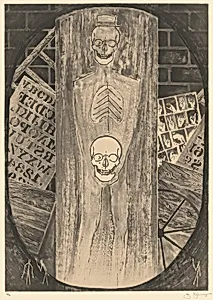
In the mid-1980s, Johns's work took a more introspective and elegiac turn, becoming overtly autobiographical and filled with references to his family, childhood events, and personal traumas. The Seasons (1985-86), a series of four large encaustic paintings representing Spring, Summer, Fall, and Winter, marks this significant shift toward autobiography. Each canvas incorporates the artist's shadowy silhouette alongside recurring motifs including skulls, rulers, and catenary lines—symbols of time, mortality, and the body's impermanence. In 1992, Johns employed a floor plan of his grandfather's house in Allendale, directly referencing the South Carolina childhood that had shaped him. These works are remarkable because a previously private and even reclusive artist chose to reveal deeply personal memories.
During this period, Johns continued to explore themes of perception, memory, and mortality with increasing complexity. Racing Thoughts (1983), created in encaustic and collage on canvas, takes its title from a psychological condition often accompanying anxiety, where the mind moves uncontrollably from one thought to another. The painting features a dense assembly of images and objects, reflecting the fragmented nature of consciousness itself. Johns also introduced the catenary motif during these years—a curve formed by a cord hanging between two fixed points—which would become central to his later work. This period saw Johns grappling with questions of aging, legacy, and the passage of time, themes that would only deepen in subsequent decades. His 1996 retrospective at the Museum of Modern Art in New York provided a comprehensive survey of his extraordinary career to that point, cementing his status as one of the most important artists of the twentieth century.
After completing his 1996 MoMA retrospective, Johns retreated to his studio in Sharon, Connecticut, and began a dramatic new body of work featuring the catenary curve as its compositional backbone. The Catenary series, which began in the late 1990s and continued into the 2000s, employed this simple mathematical curve to structure increasingly complex compositions. In these works, Johns utilized various media including acrylic, collage, watercolor, and gouache over aquatint and etching, layering multiple motifs to generate new meanings. The catenary became a metaphor for both physical weight and psychological burden, linking to his earlier imagery of falling bodies—divers, mountaineers—and suggesting what one critic described as 'both an arc—like that of a bridge, a diver, or a catenary—or an undersea chamber, a secret, even a tomb.'
In 2007, Johns created Numbers, the largest single bronze sculpture he had made to date, depicting his classic pattern of stenciled numerals repeated in a grid. After it was cast in aluminum, the original wax still existed, and this damaged piece became the basis for six two-sided sculptures cast in bronze, aluminum, and silver. The Regrets series (2013-14) represents another significant late work, layering themes of memory, replication, and erasure while addressing male relationships—specifically between Lucian Freud and Francis Bacon—dynamics as creatively generative and emotionally fraught as Johns's own relationship with Rauschenberg. In 2021-22, Johns was honored with Jasper Johns: Mind/Mirror, an unprecedented retrospective simultaneously staged at the Whitney Museum of American Art in New York and the Philadelphia Museum of Art. Each institution presented a self-contained exhibition, with the two halves mirroring one another—a fitting metaphor for an artist whose work has consistently explored doubling, reversal, and perception. Now in his nineties, Johns continues to work from his Connecticut studio, maintaining his decades-long practice of rigorous formal experimentation combined with deeply personal content. He has announced plans to transform his 170-acre property in Sharon into an artists' residency that will provide live-work space for 18 to 24 artists at a time, ensuring his legacy of supporting and nurturing artistic innovation extends beyond his own remarkable production.
Biography length: ~2,847 words

![Usuyuki [working proof]](https://images.artheonmuseum.org/nga/thumb/usuyuki-working-proof-nga-142891.webp)
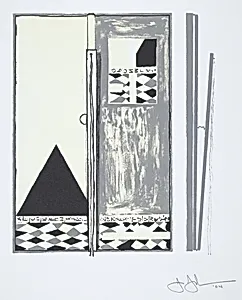
![Untitled [working proof]](https://images.artheonmuseum.org/nga/thumb/untitled-working-proof-nga-151734.webp)
![Untitled [working proof]](https://images.artheonmuseum.org/nga/thumb/untitled-working-proof-nga-151736.webp)
![Untitled [working proof]](https://images.artheonmuseum.org/nga/thumb/untitled-working-proof-nga-151735.webp)
![Untitled [state proof of 4th state]](https://images.artheonmuseum.org/nga/thumb/untitled-state-proof-of-4th-state-nga-151738.webp)
![Untitled [state proof of 5th state]](https://images.artheonmuseum.org/nga/thumb/untitled-state-proof-of-5th-state-nga-151740.webp)
![Untitled [state proof of 5th state]](https://images.artheonmuseum.org/nga/thumb/untitled-state-proof-of-5th-state-nga-151739.webp)
![Untitled [state proof of 6th state]](https://images.artheonmuseum.org/nga/thumb/untitled-state-proof-of-6th-state-nga-151741.webp)
![Untitled [state proof of 8th state]](https://images.artheonmuseum.org/nga/thumb/untitled-state-proof-of-8th-state-nga-151743.webp)
![Untitled [trial proof]](https://images.artheonmuseum.org/nga/thumb/untitled-trial-proof-nga-151748.webp)
![Untitled [trial proof]](https://images.artheonmuseum.org/nga/thumb/untitled-trial-proof-nga-151749.webp)
![Untitled [trial proof]](https://images.artheonmuseum.org/nga/thumb/untitled-trial-proof-nga-151750.webp)
![Untitled [trial proof]](https://images.artheonmuseum.org/nga/thumb/untitled-trial-proof-nga-151752.webp)
![Untitled [trial proof]](https://images.artheonmuseum.org/nga/thumb/untitled-trial-proof-nga-151753.webp)
![Untitled [trial proof]](https://images.artheonmuseum.org/nga/thumb/untitled-trial-proof-nga-151755.webp)
![Untitled [trial proof]](https://images.artheonmuseum.org/nga/thumb/untitled-trial-proof-nga-151756.webp)
![Untitled [trial proof]](https://images.artheonmuseum.org/nga/thumb/untitled-trial-proof-nga-151759.webp)
![Untitled [trial proof]](https://images.artheonmuseum.org/nga/thumb/untitled-trial-proof-nga-151757.webp)
![Untitled [trial proof]](https://images.artheonmuseum.org/nga/thumb/untitled-trial-proof-nga-151761.webp)
![Untitled [trial proof]](https://images.artheonmuseum.org/nga/thumb/untitled-trial-proof-nga-151763.webp)