Ctrl K
1763–1789
Jean-Henri-Alexandre Pernet (c. 1763–after 1789) was a French artist whose brief career centered on intricate architectural fantasies, capturing the imagination of late 18th-century viewers with his masterful use of watercolor and gouache. Born around 1763, Pernet's early life remains sparsely documented, though records from 1783 place him at age twenty, living with his family on the Rue d’Argenteuil in Paris. That year, he appeared on the rolls of the Académie Royale de Peinture et de Sculpture, marking his formal entry into the prestigious institution that shaped French artistic training during the Ancien Régime.
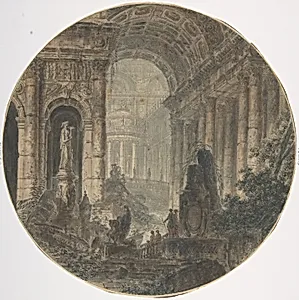
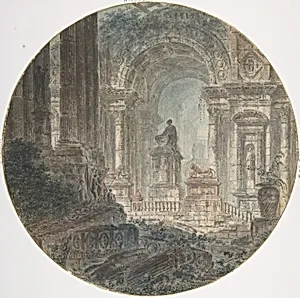
Pernet studied under the painter Pierre-Antoine Demachy, a specialist in architectural views and vedute, whose influence is evident in Pernet's affinity for dramatic, imaginary ruins and vaulted interiors. Working in the tradition of the Académie Royale, Pernet produced exclusively drawings rather than oils, despite being listed as a painter. His style evoked the capriccios of Giovanni Battista Piranesi, organizing vast, fantastical spaces in diagonal strata with meticulous detail and atmospheric depth. These works, often on a grand scale, blended real architectural elements—Roman vaults, porticos, and classical motifs—with invented grandeur, reflecting the era's fascination with antiquity amid the eve of the French Revolution.
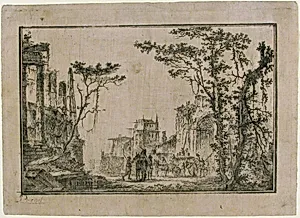
Among his surviving major works are the *Architectural Capriccio* at the Morgan Library & Museum, New York, praised for its Piranesian echoes; *Interior of a Vaulted Chamber* (ca. 1780s, Morgan Library, 2001.23); an *Architectural Fantasy* attributed to him at the Metropolitan Museum of Art; and *Ruins of Athens with a Vaulted Portico*, a collaboration with Laurent Guyot featured in collections like the National Gallery of Art. Though his output was limited by his early death around 1789, Pernet's drawings endure in prestigious institutions such as the Thyssen-Bornemisza Museum and Art UK holdings, celebrating his talent for evoking sublime, otherworldly spaces. Today, he represents a fleeting brilliance in the transition from neoclassical precision to Romantic reverie, reminding us of the unsung draftsmen who enriched Europe's visual heritage.
All 3 artworks loaded