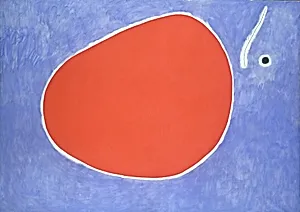
Joan Miró i Ferrà, a pioneering Catalan painter, sculptor, and ceramist born in Barcelona, Spain, on April 20, 1893, initially balanced familial expectations with his artistic calling. The son of goldsmith Miquel Miró Adzerias and Dolores Ferrà, he began drawing lessons at age seven in a private Barcelona school before enrolling in business college and working as a clerk. A nervous breakdown prompted his full commitment to art; he studied under Francisco Galí at the Escola d'Art de Francesc Galí and the Escola de Belles Arts de la Llotja starting in 1907, as well as the Cercle Artístic de Sant Lluc until 1918, where Galí encouraged intuitive drawing by touch, often blindfolded.
Miró's style evolved through precise, detailed compositions in his early "Catalan Fauvist" phase, influenced by van Gogh and Cézanne, before embracing Surrealism after moving to Paris in 1920. Though he signed the 1924 Surrealist manifesto and André Breton hailed him as "the most Surrealist of us all," Miró rejected strict affiliation, blending dream-like automatism, biomorphic forms, and playful symbols like stars, birds, and women with Catalan folk elements. His works rejected bourgeois conventions, incorporating collage, lyrical abstraction, and subconscious imagery to evoke poetic fantasy amid modern harshness.
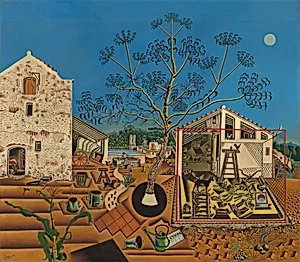
Among his masterpieces are *The Farm* (1921–1922), a meticulously rendered yet abstract Catalan landscape; *The Tilled Field* (1923–1924) and *Harlequin's Carnival* (1924–1925), evoking subconscious reverie; *Dog Barking at the Moon* (1926); the politically charged mural *The Reaper* (1937); and the *Constellations* series (1940–1941). Later highlights include *Blue II* (1961) and monumental sculptures like *The Sun, the Moon and One Star* (1981) in Chicago.
Miró's legacy endures through institutions like Barcelona's Fundació Joan Miró (1975) and Palma's Fundació Pilar i Joan Miró (1981), alongside his profound influence on postwar abstraction. Married to Pilar Juncosa since 1929 with daughter María Dolores, he produced over 1,000 lithographs and public works, including New York tapestries, cementing his role as a bridge between European Surrealism and global modernism. This virtual museum proudly holds 100 of his vibrant works, celebrating his childlike wonder and revolutionary spirit until his death in Palma on December 25, 1983.

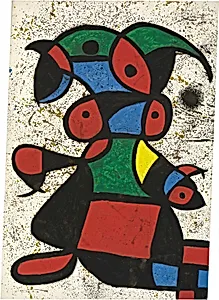
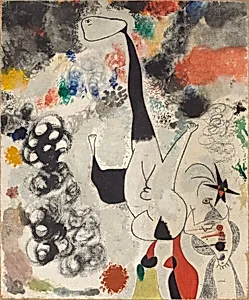
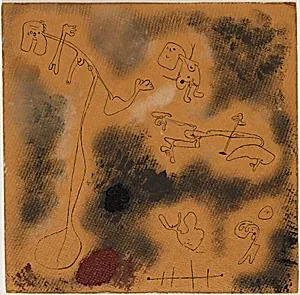
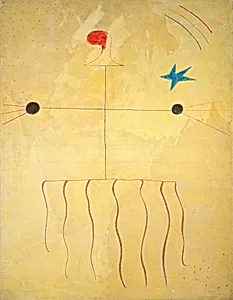
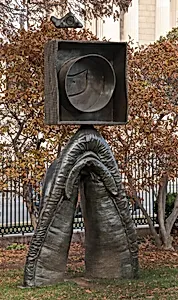
![Untitled [plate LXV]](https://images.artheonmuseum.org/nga/thumb/untitled-plate-lxv-nga-47057.webp)
![Untitled [plate LXIV]](https://images.artheonmuseum.org/nga/thumb/untitled-plate-lxiv-nga-47056.webp)
![Untitled [plate LXVI]](https://images.artheonmuseum.org/nga/thumb/untitled-plate-lxvi-nga-47058.webp)
![Untitled [plate LXVII]](https://images.artheonmuseum.org/nga/thumb/untitled-plate-lxvii-nga-47059.webp)
![Untitled [plate LXVIII]](https://images.artheonmuseum.org/nga/thumb/untitled-plate-lxviii-nga-47060.webp)
![Untitled [plate LXIX]](https://images.artheonmuseum.org/nga/thumb/untitled-plate-lxix-nga-47061.webp)
![Untitled [plate LXXI]](https://images.artheonmuseum.org/nga/thumb/untitled-plate-lxxi-nga-47063.webp)
![Untitled [plate LXX]](https://images.artheonmuseum.org/nga/thumb/untitled-plate-lxx-nga-47062.webp)
![Untitled [plate LXXIII]](https://images.artheonmuseum.org/nga/thumb/untitled-plate-lxxiii-nga-47065.webp)
![Untitled [plate LXXIV]](https://images.artheonmuseum.org/nga/thumb/untitled-plate-lxxiv-nga-47066.webp)
![Untitled [plate LXXVII]](https://images.artheonmuseum.org/nga/thumb/untitled-plate-lxxvii-nga-47069.webp)
![Untitled [plate LXXVIII]](https://images.artheonmuseum.org/nga/thumb/untitled-plate-lxxviii-nga-47070.webp)
![Untitled [plate LXXIX]](https://images.artheonmuseum.org/nga/thumb/untitled-plate-lxxix-nga-47071.webp)
![Untitled [plate LXXVI]](https://images.artheonmuseum.org/nga/thumb/untitled-plate-lxxvi-nga-47068.webp)
![Untitled [plate LXXX]](https://images.artheonmuseum.org/nga/thumb/untitled-plate-lxxx-nga-47072.webp)
![Untitled [plate XXVIII]](https://images.artheonmuseum.org/nga/thumb/untitled-plate-xxviii-nga-47020.webp)
![Untitled [plate LXXV]](https://images.artheonmuseum.org/nga/thumb/untitled-plate-lxxv-nga-47067.webp)