Ctrl K
**Johann Georg Christoph Fries (1788–1857)** was a versatile German figure in the theater world, renowned as an opera singer (bass), actor, stage designer, and costume designer. Born in Nuremberg, he launched his multifaceted career in 1809 at the Theater Bamberg, debuting as an actor while also serving as a stage designer and receiving singing instruction from the composer and critic E. T. A. Hoffmann. Fries continued honing his vocal talents under soprano Caroline Reuter during his tenure at the Nuremberg Theater from 1811 to 1816. Despite some setbacks, including unsuccessful guest appearances in cities like Munich, Hanover, Berlin, and Vienna, he secured a pivotal position in 1820 at the Munich Court Theater (Hoftheater München), where he remained until his retirement in July 1857. There, he not only performed but also excelled as a costume designer and decoration painter, contributing to the visual splendor of opera productions.
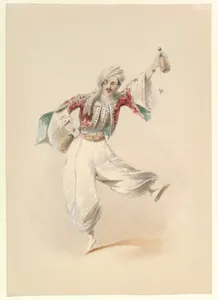
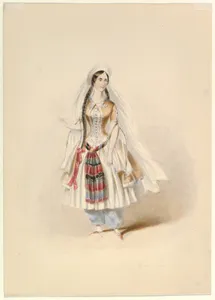
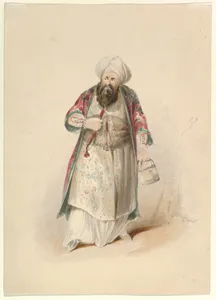
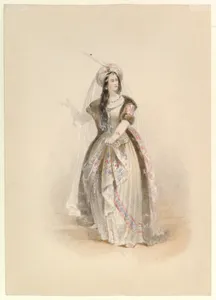
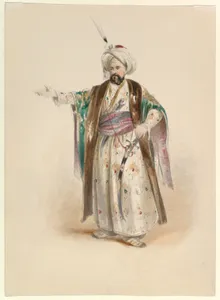
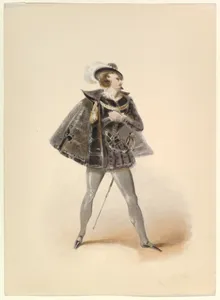
Fries's artistic output is epitomized by his exquisite costume studies for Wolfgang Amadeus Mozart's opera *Die Entführung aus dem Serail* (*The Abduction from the Seraglio*), created around 1830–1850. Working primarily in watercolor over graphite heightened with gum arabic, he produced detailed designs for key characters including Blonde, Belmonte, Osmin, Pedrillo, Bassa Selim, and Konstanze. These works, once misattributed to the younger Angelo Quaglio (1829–1890), showcase Fries's mastery of theatrical realism, capturing intricate fabrics, accessories, and poses with precision suited to stage illumination. His designs reflect the Romantic era's fascination with exotic Orientalism, tailored for Mozart's Turkish singspiel, and demonstrate his deep integration of performance and visual arts.
Though Fries's early training in scenic design remains sparsely documented beyond his practical debut, his long service at Munich's premier venue positioned him within the vibrant tradition of German court theater design, akin to the Quaglio family's legacy in scenic innovation. A dozen of his costume studies survive in major collections, including six at The Metropolitan Museum of Art, preserving his contributions to 19th-century opera staging. Fries died in Regensburg on November 10, 1857, leaving a legacy as a behind-the-scenes artisan whose vivid designs enhanced the dramatic allure of Europe's operatic stages, bridging music, acting, and visual spectacle in an era of theatrical grandeur.