
Ctrl K
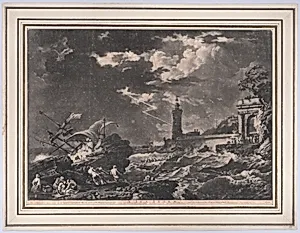
**Claude-Joseph Vernet (1714–1789)** was a leading French landscape and marine painter of the eighteenth century, renowned for his atmospheric seascapes, dramatic shipwrecks, and luminous harbor views. Born in Avignon on 14 August 1714, he received his initial training from his father, the decorative painter Antoine Vernet, before studying with the history painter Philippe Sauvan and the landscape artist Jacques Viali in Aix-en-Provence.
Vernet spent nearly two decades in Rome (1734–1753), where he immersed himself in the classical landscape tradition of Claude Lorrain and the dramatic, picturesque style of Salvator Rosa. This period shaped his signature approach: idealized yet vividly observed scenes that captured the play of light, weather, and atmosphere on the sea. Upon returning to France, he became a member of the Royal Academy and received a major royal commission from Louis XV to paint a series documenting the ports of France (1754–1765), a landmark project that remains among his most celebrated achievements.
Vernet’s family maintained a strong artistic legacy; his son Carle Vernet and grandson Horace Vernet both became notable painters, while his daughter Marguerite Émilie Chalgrin also pursued art. His works were widely disseminated through engravings published in London by firms such as John Bowles & Son and Robert Sayer, extending his influence across Europe. Today, Vernet is remembered as one of the foremost marine painters of his era, whose sensitive depictions of nature’s moods helped define the taste for sentimental, atmospheric landscape painting in the later eighteenth century.