
Ctrl K
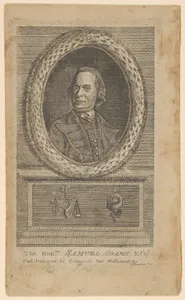
**John Norman (ca. 1748–1817)** was an English-born engraver and publisher who became one of the most active printmakers in post-Revolutionary Boston. Born in England, he arrived in Philadelphia in 1774, advertising himself as an “architect and landscape engraver” trained in London. He relocated to Boston around 1780, where he established a shop and remained active until his death in 1817; he was buried in Copp’s Hill Burying Ground.)
Norman worked primarily in etching and engraving, producing architectural illustrations, sea charts, book plates, and portraits. His output helped disseminate both practical knowledge and patriotic imagery in the early republic. Notable works include the illustrations for *The Town and Country Builder’s Assistant* (1786), coastal charts of Maine and the Carolinas published in the 1790s and early 1800s, and a well-known bust-length portrait of Samuel Adams (1781–83).
Although little is recorded about formal training beyond his London origins, Norman’s precise line work and attention to architectural detail reflect the professional standards of British printmaking that he brought to America. He also engraved maps, scientific diagrams, and occasional historical scenes, demonstrating versatility across commercial and fine-art applications.
Norman’s legacy lies in his role as a bridge between European engraving traditions and the emerging American market for prints. His charts and architectural plates supported navigation, building, and education, while his portraits helped shape visual memory of Revolutionary leaders. Today his works are held in major collections, including the Metropolitan Museum of Art and the Worcester Art Museum, where they document the development of American graphic arts in the Federal period.
All 1 artworks loaded