
Ctrl K
1839–1922
Joseph Parkin Mayall (1839–1922) was a British photographer born in Huddersfield, Yorkshire, as the second son of the renowned daguerreotypist John Jabez Edwin Mayall and Eliza Parkin. Originally named Joe Meal, he grew up in a family that adopted the Mayall surname and built a prominent photography business with studios across London, Brighton, and even Melbourne. Mayall trained directly under his father, assisting in sessions that captured members of the royal family and other distinguished sitters, and he identified himself as an artist from early in his career. Photography became a family enterprise, with his brothers Edwin and John also entering the profession.
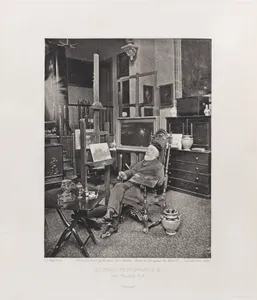
Mayall established his own practice in Brighton in the late 1860s before relocating to Australia around 1870, where he opened a Melbourne studio, exhibited portrait work at major intercolonial exhibitions, and continued the family tradition of high-quality portraiture. After a tragic family accident, he returned to England and, in 1883, opened the Park Lane Studio in London. There he produced his most celebrated body of work: the 1884 luxury portfolio *Artists at Home*, a series of photogravures published by Sampson Low, Marston, Searle & Rivington with accompanying text by F. G. Stephens. The project featured leading Victorian painters and sculptors in their studios and domestic settings, including a notable portrait of Richard Redgrave. Mayall actually created far more images than the twenty-five published plates, capturing the artists amid their easels, sculptures, and personal collections.
These environmental portraits emphasized atmosphere and character over mere likeness, and Mayall used them to argue that photography could rival painting in conveying personality and refinement. He later maintained a studio in Kilburn and continued working into the early twentieth century. Mayall died in London in 1922 at the age of eighty-three. His *Artists at Home* images remain an invaluable visual archive of the late-Victorian art world, preserving the working environments and public personae of a generation of Royal Academicians and helping to elevate photography’s status as a fine art. Today they are held in major collections and continue to inform our understanding of how artists presented themselves and their studios to the public.