1815–1900
Julius Friedrich Antonio Schrader was born on June 16, 1815, in Berlin, Prussia, the son of the painter, copyist, and restorer Antonio Schrader. He began his artistic training at the Prussian Academy of Arts in Berlin from 1830 to 1832, laying the foundation for his career in historical and portrait painting. Seeking further refinement, Schrader moved to the Kunstakademie Düsseldorf in 1837, where he studied under the renowned Friedrich Wilhelm von Schadow for seven years, immersing himself in the Düsseldorf school of painting's emphasis on meticulous detail, dramatic narratives, and romantic realism.
Following his time in Düsseldorf, Schrader embarked on extensive travels that broadened his palette and technique. He resided in Rome from 1845 to 1847, then visited England, the Netherlands, Belgium, and France, where he absorbed the vibrant colorism of Belgian artists Louis Gallait and Édouard De Bièfve, echoing influences from Rubens and Van Dyck. Returning to Berlin, he was appointed professor at the Prussian Academy of Arts in 1851 (some sources note 1856), serving until 1892 and later at the Academy of Fine Arts from 1875. His style evolved within the Düsseldorf tradition, favoring grand history paintings that captured pivotal moments with emotional intensity and luminous color.
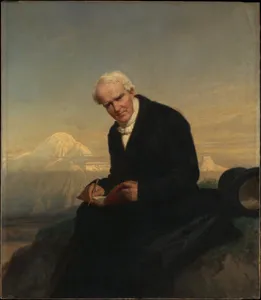
Schrader's oeuvre includes iconic history paintings such as *Surrender of Calais to Edward III* (1847), *Frederick the Great after the Battle of Kolin* (1849), *Death of Leonardo da Vinci* (1851), *Milton and His Daughters* (1855), *Esther before Ahasuerus* (1856), and *Cromwell at the Death-Bed of His Daughter* (1859). He excelled in portraits of luminaries like Alexander von Humboldt (1859, Metropolitan Museum of Art) and historian Leopold von Ranke (1868, Nationalgalerie Berlin), as well as monumental frescoes including the *First Twelve Christian Monarchs* in Berlin's Royal Chapel and the *Consecration of the Church of Saint Sophia* in the New Museum.
Schrader's legacy endures as a pillar of the Düsseldorf school, bridging romantic historicism with Prussian academic rigor. Elected to the Prussian Academy in 1847 and named professor in 1852, he shaped generations of artists through teaching while adorning Berlin's public spaces. His works, blending narrative depth with opulent color, remain celebrated in museums worldwide, exemplifying 19th-century German art's grandeur.
