
Ctrl K
**Juste-Nathan François Boucher (1736–1782)**
Born on May 4, 1736, in Paris, Juste-Nathan François Boucher—known as Boucher fils—entered a prominent artistic dynasty as the son of the celebrated Rococo painter François Boucher and his wife, Marie-Jeanne Boucher. Little is documented about his early training, though his familial connections likely immersed him in the vibrant world of 18th-century French ornamental design from a young age. By his twenties, Boucher had established himself as an architect and painter of ornament, specializing in intricate decorative motifs that blended architectural precision with fanciful embellishments. He died in Paris in January 1782 at the age of 45.
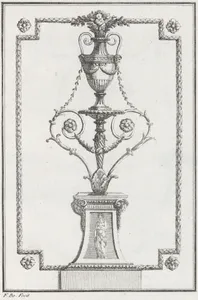
Boucher's oeuvre is renowned for its printed suites of designs, which captured the opulent tastes of the Ancien Régime and influenced interior decorators, furniture makers, and goldsmiths across Europe. Among his major works are the *Recueil de décorations intérieures* (c. 1775), a comprehensive set of sixty plates depicting lavish room schemes, furniture arrangements, and altars, published by Jacques-François Chéreau. He produced multiple *Cahiers d'Arabesques*—up to the eighth volume around 1780—featuring scrolling foliage, vases, and figural elements, often etched himself or in collaboration with engravers like A. Duval (as in *Plans et Élévations de Retables d'Autels Ornés*, c. 1774). Other notable series include the *Nouveau Livre de Vases* (1755–67) and *Suite de Douze Vases*, alongside the multi-volume *Oeuvres* (1750–82), engraved by artists such as Jean Pelletier and published by Le Pere et Avaulet. He also designed the decor for the Lyon country house *La Norenchal*, now preserved at the Musée des Beaux-Arts de Lyon.
Working in the transitional Rococo-to-Neoclassical style, Boucher's designs emphasized symmetry, classical motifs like Corinthian columns, and playful grotesques, reflecting the era's fascination with antiquity revived through French elegance. His close ties with the Chéreau publishing house ensured wide dissemination of his patterns, from wall elevations and breakfast tables to portable baths and medal engravings. Though his career was cut short, Boucher's legacy endures in museum collections worldwide, including the Metropolitan Museum of Art and Victoria and Albert Museum, where his prints serve as enduring blueprints for 18th-century decorative arts. His father's renown amplified his reach, cementing the Boucher name in the annals of French design.