
Ctrl K
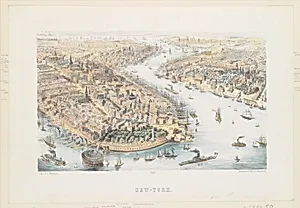
K. Th. Westermann was a German lithographer active around 1852, best known for his panoramic hand-colored lithograph *New-York (From the Southwest)*. Little is known about his early life, training, or teachers, as biographical details remain scarce in art historical records. His sole documented work captures a sweeping aerial view of mid-19th-century Lower Manhattan from the southwest, showcasing the bustling harbor, Castle Garden, and early skyscrapers amid a forest of masts from incoming ships. Measuring 8 7/8 x 14 9/16 inches on a larger sheet, the print exemplifies the technical precision of lithography, a popular medium for disseminating exotic cityscapes across Europe during an era of rapid transatlantic exchange.
Published by fellow German Franz Wentzel in Weissenburg (now Wissembourg, Alsace), the lithograph reflects the collaborative printmaking culture of the time, where specialized lithographers like Westermann transferred drawn images onto stone for mass reproduction. Wentzel operated what was likely a Kunstanstalt, or art printing establishment, producing views of distant locales that captivated European audiences fascinated by America's growth. Westermann's style aligns with the topographic tradition of detailed urban panoramas, emphasizing architectural landmarks and maritime activity without overt romanticism, prioritizing documentary clarity over artistic flourish.
Today, the print resides in the Metropolitan Museum of Art's Edward W. C. Arnold Collection (object 54.90.769), offering a rare European perspective on New York just before the Civil War. Westermann's obscurity underscores the ephemeral nature of commercial lithography, where countless skilled practitioners contributed to visual culture but faded from prominence. Yet, through this vivid survivor, his work endures as a testament to 19th-century print technology's role in globalizing urban imagery, bridging Old World craftsmanship with New World ambition. No other major works by Westermann are cataloged, cementing his legacy in this singular, evocative depiction.