
Ctrl K
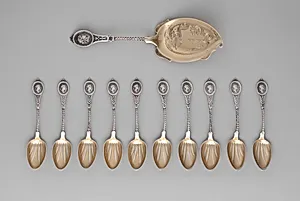
**Kidney, Cann & Johnson** (later **Kidney & Johnson**) was a New York City silversmithing partnership active primarily from 1863 into the 1870s, specializing in coin silver flatware and hollowware during a period of rapid growth in the American silver industry.
The firm’s principals included Edmund Kidney (1821–1875), who had earlier partnered with William Adams until around 1862; John Cann; and Samuel H. Johnson. The partnership formed as Kidney, Cann & Johnson in 1862/1863, briefly became Kidney & Cann when Johnson departed in 1864, then reverted to its original name in 1865 before Cann left in 1868, after which it operated as Kidney & Johnson until roughly 1874.
These silversmiths contributed to the mid-nineteenth-century efflorescence of American silver design, producing ornate “medallion” flatware patterns inspired by antique coins and cameos that appealed to the expanding middle class. Their output included both everyday and specialized serving pieces, such as the unmarked but stylistically attributable ice cream slicer and ten matching spoons (ca. 1863) now in the Metropolitan Museum of Art.
The firm’s work reflects the era’s technical and aesthetic advances, including the use of silver-gilt accents and the creation of dedicated utensils for newly popular desserts like ice cream. While individual biographies of the partners remain limited, their collaborative production helped supply the refined luxury goods that defined Victorian American dining culture. Today, surviving examples of their silver continue to appear in museum collections and the market, documenting a brief but distinctive chapter in nineteenth-century American metalwork.