
Ctrl K
**Luca Bertelli (active 1564–1589)**
Luca Bertelli emerged as a prominent figure in Venice's vibrant print trade during the second half of the 16th century, working as a libraio (bookseller), engraver, and one of the city's leading publishers. Part of a family of Italian typographers, engravers, publishers, and print dealers, he was likely related to fellow printmaker Ferrando Bertelli, though details of his early life and formal training remain undocumented. Active primarily in Venice around 1560 and later in Padua circa 1594, Bertelli collaborated with notable artists and engravers including Martino Rota, Gaspare Oselli, and Agostino Carracci, often commissioning or executing reproductive prints after renowned masters.
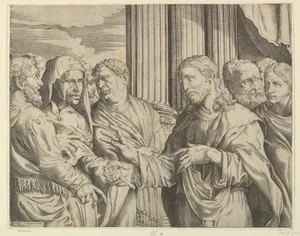
Bertelli's oeuvre consists largely of engravings that faithfully reproduced compositions by leading Venetian painters, capturing their dramatic narratives and intricate details in the etched line. He worked in the tradition of Venetian reproductive printmaking, producing works such as the *Martyrdom of Saint Peter Martyr* after Titian (c. 1567), *Vanitas* (1578), *Temptation of St. Anthony* (c. 1550–1580), and several after Domenico Campagnola, including *The Tribute Money*, *Souls in Hell*, and *Banquet of the Rich Man and Lazarus* (ca. 1565–89). These prints, marked with his monogram or publication tablet (e.g., "Luca Bertelli f."), demonstrate his skill in translating paintings and drawings into accessible multiples, often with rich tonal effects.
Though the extent of Bertelli's personal engraving contributions versus his publishing role is sometimes debated, his enterprise played a crucial role in disseminating Venetian art across Europe. By facilitating the reproduction of works by Titian, Tintoretto, and others, he contributed to the commercialization of Renaissance imagery, bridging the gap between elite painting and broader audiences in an era of expanding print culture.
**Domenico Campagnola (c. 1500–1564)**
Born around 1500, probably in Venice to German-extracted parents, Domenico Campagnola was adopted as a young boy by the engraver and painter Giulio Campagnola, under whom he trained as a draughtsman and printmaker; he was also the grandson of the Paduan humanist and painter Girolamo Campagnola. Closely associated with Titian's workshop—possibly as a pupil—he contributed landscape backgrounds to the master's paintings and immersed himself in the Venetian Renaissance milieu, later basing himself in Padua from the early 1520s until his death there in 1564.
A versatile painter and pioneering printmaker, Campagnola excelled in engravings and woodcuts that mimicked the spontaneity of drawings, particularly landscapes with figures. Following his adoptive father's style and Titian's influence, he produced fourteen engravings in a burst from 1517–18, including *Old Soldier and Shepherd*, *Battle of Naked Men*, and *Assumption* (all 1517); the woodcut *Massacre of the Innocents* (in two blocks); and collaborative efforts like *Concert by a Brook* with Giulio. His paintings featured animated frescoes in Padua's Scuola del Santo and Venice, as well as the panel *Adam and Eve* in Florence's Pitti Palace. Late drawings, such as *Banquet of the Rich Man and Lazarus*, served as models for engravers like Luca Bertelli.
Campagnola's innovation lay in producing finished landscape drawings for direct sale—one of the first to do so—and cutting his own woodblocks, debasing early mannered landscapes into facile formulas that inspired generations of Italian draughtsmen, from the Carracci brothers to Domenichino and Grimaldi. Despite a fallout with Titian over print forgeries, his prints popularized the landscape genre, making Venetian naturalism widely accessible and cementing his legacy in Renaissance graphic arts.